Archive / Repetitions
Butchery
Following the politically charged works of the late 1990s, particularly Der Capital, Butchery marked a shift in my attention from global events towards the politics of identity. At the turn of the millennium there was a sense of optimism in Britain. The millennium celebrations, economic confidence and the cultural mood surrounding "Cool Britannia" suggested a more hopeful future, before the events of 11 September 2001 altered that atmosphere. Rather than looking outward at international politics, I began looking much closer to home.
The title Butchery operates on several levels. "Butch" has long been associated with toughness and masculinity. Within the LGBTQ+ community it later acquired different meanings, but growing up in a working-class environment it was simply a word used to describe hard, masculine boys. Combined with its obvious association with meat, the title became a way of thinking about how masculine identity is performed, consumed and reduced to a series of cultural stereotypes. The paintings are not really about sport; they are about the rituals of competition, aggression and tribalism that sport so often performs.
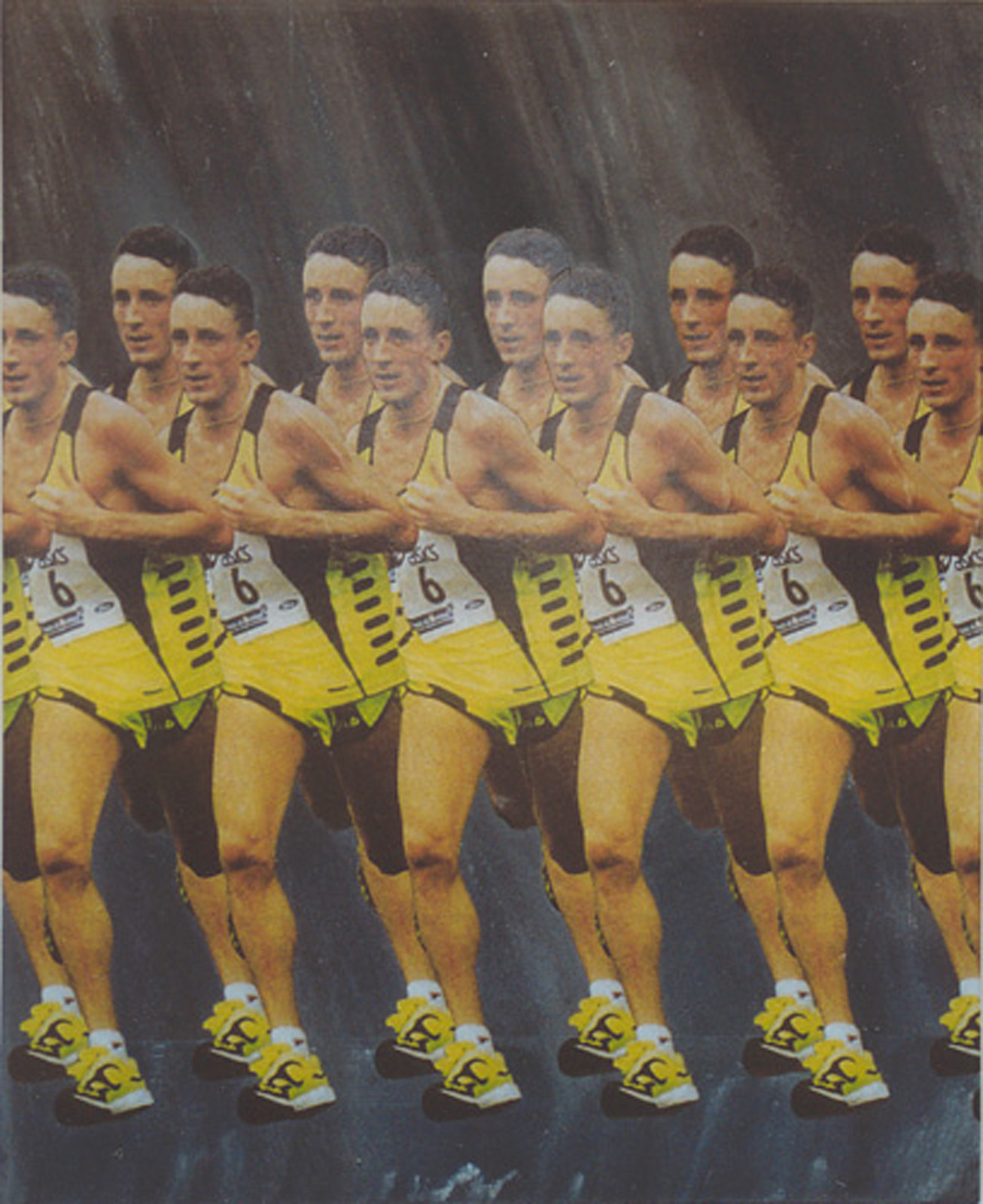
Ham Strings
2000 · mixed media on canvas · 108 × 88 cm
Goldman Sachs Collection
Ham Strings takes its title from the familiar sporting injury, but the painting quickly moves beyond athletics itself. Rows of runners are collaged so that neighbouring figures share the same pair of legs. Individual bodies begin to merge, confusing one competitor with another until the race becomes an absurd choreography of entangled limbs. The work reflects the desire to gain an advantage over an opponent, to trip, obstruct or outmanoeuvre them, revealing the competitive instinct that often lies beneath the ideals of fair play.
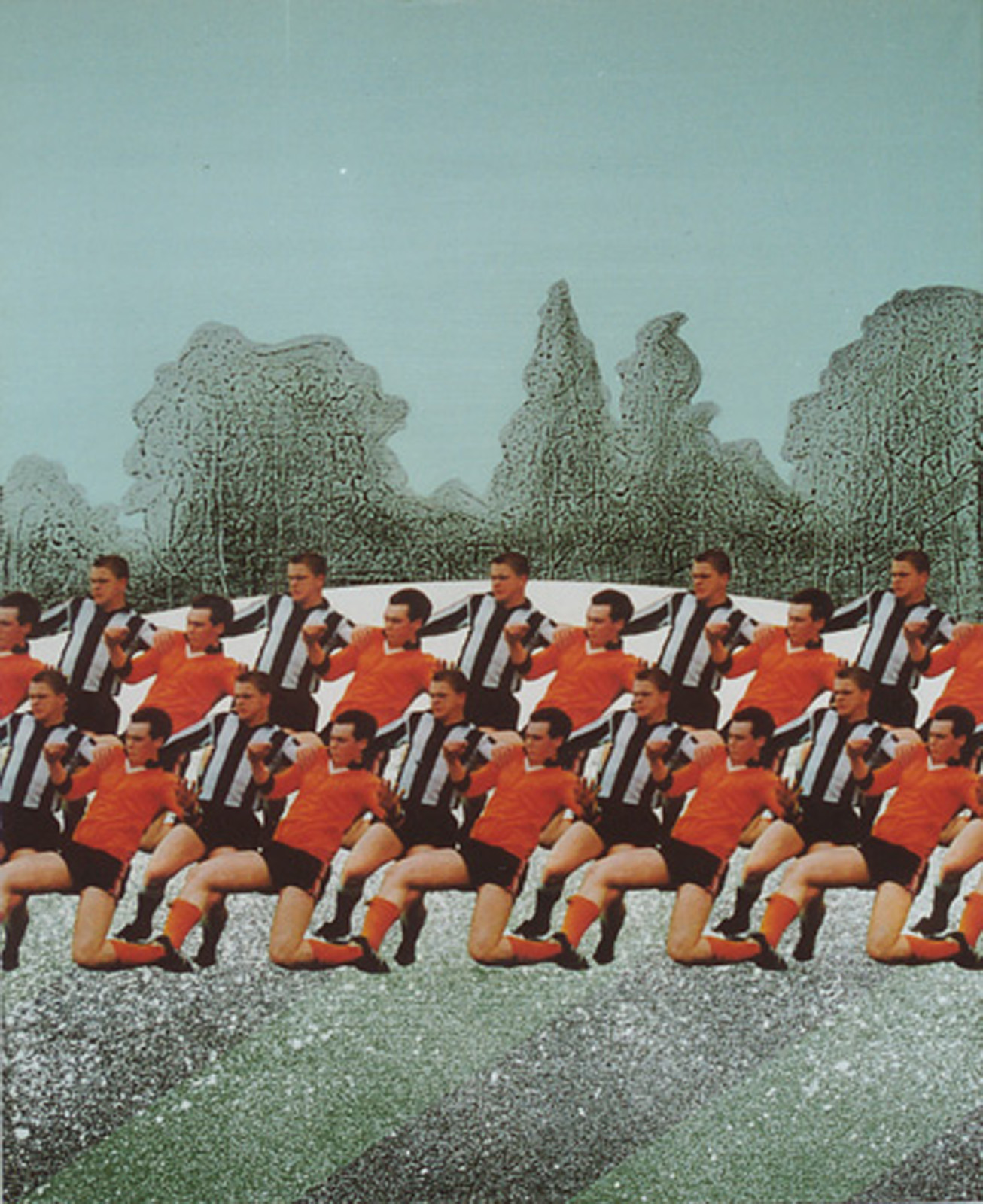
Bully Beef
2000 · mixed media on canvas · 108 × 88 cm
Bully Beef presents footballers locked together on a snow-covered pitch. The black stripes play against the orange shirts in what appears to be a fierce challenge, yet there is one significant absence: there is no football. Removed from the game itself, the image becomes simply a confrontation. What remains is not sport, but tribalism, intimidation and physical conflict. Without the ball, the purpose of the encounter disappears, exposing the aggression as an end in itself.
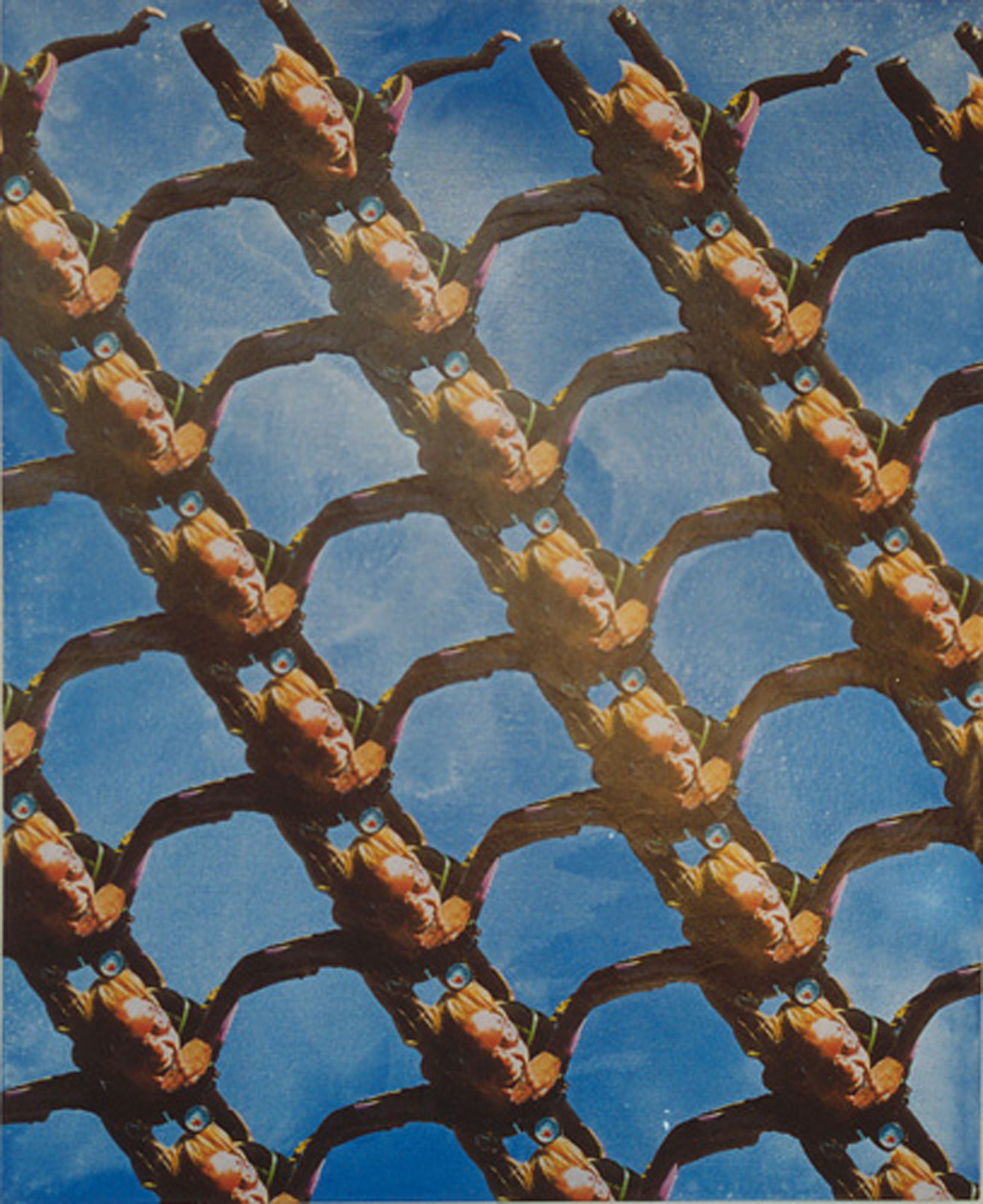
Pork Chops
2000 · mixed media on canvas · 108 × 88 cm
Pork Chops is perhaps the most unsettling work in the series. Repeated images of skydivers appear to strike one another across the canvas, but through repetition they gradually lose their individuality, locking together to form a chain-link fence. It is not intended to be a beautiful painting. Its awkwardness is part of its function. The fence becomes a metaphor for the social structures created through repeated performances of masculinity: barriers that separate belonging from exclusion, strength from weakness, and "us" from "them". The violence ceases to belong to any single individual and instead becomes structural, woven into the fabric of the image itself.
Viewed together, the paintings examine the performance of masculinity rather than sport itself. Competition, aggression and ideas of toughness become repeated cultural gestures, rehearsed until they appear natural. As with the other works in the Repetitions series, familiar images are dismantled and reconstructed through collage, allowing them to reveal the systems of behaviour hidden beneath their everyday appearance. Here, repetition transforms not only the image, but our understanding of the culture it represents.