Exhibitions / Group
Vim and Vigour
S1 Artspace, Sheffield
26 March – 15 April 2000
Exhibition History
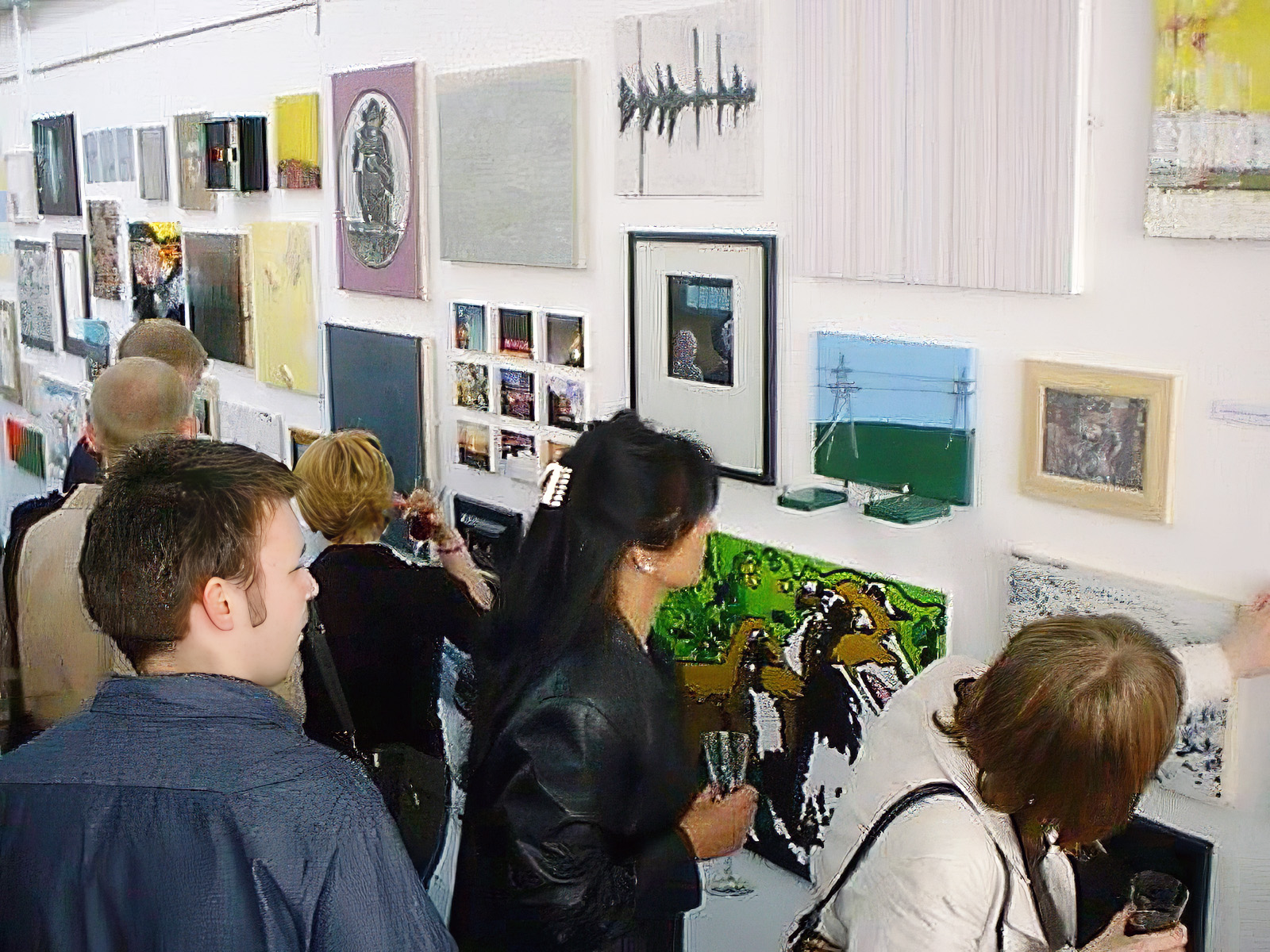
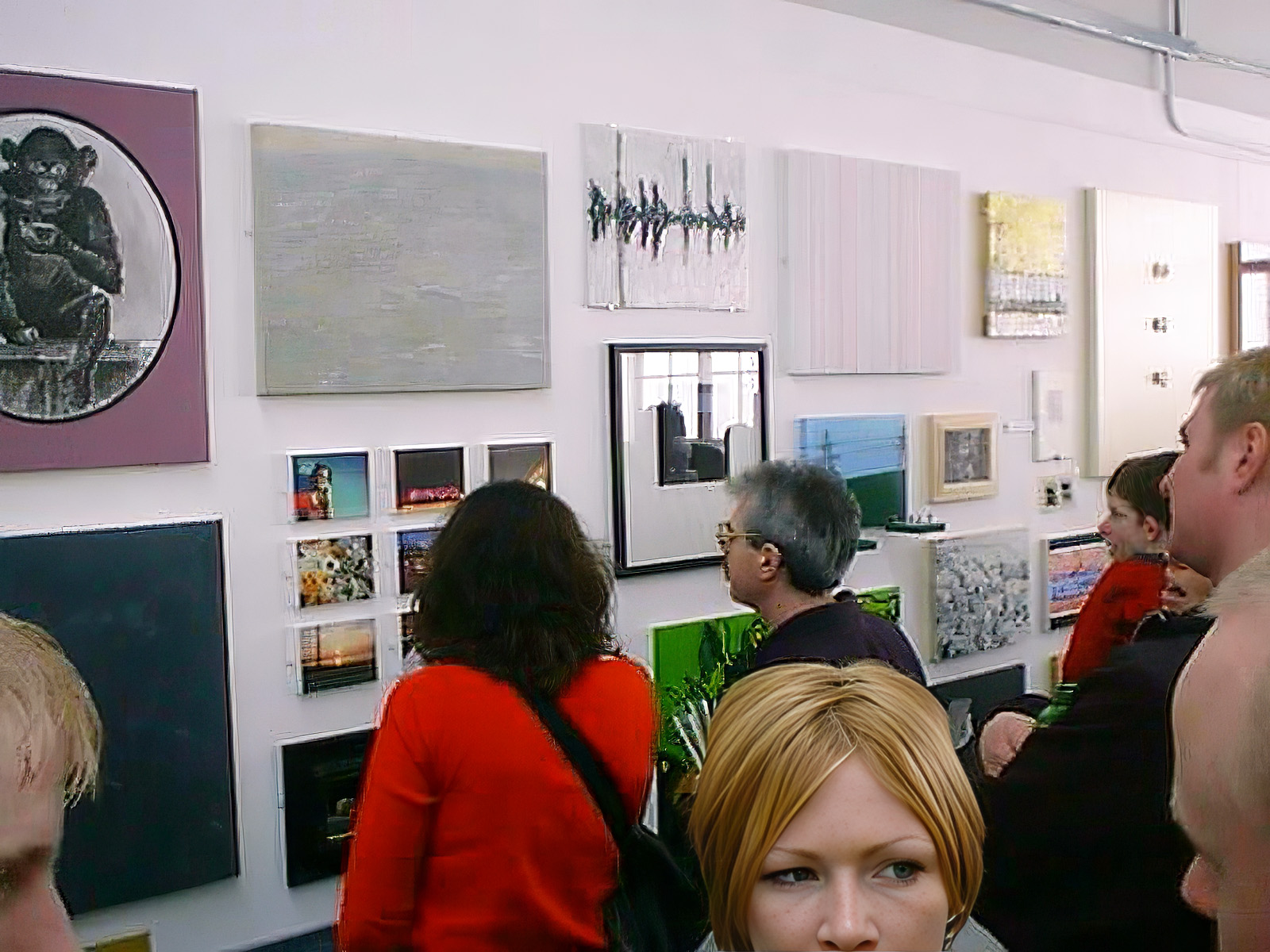
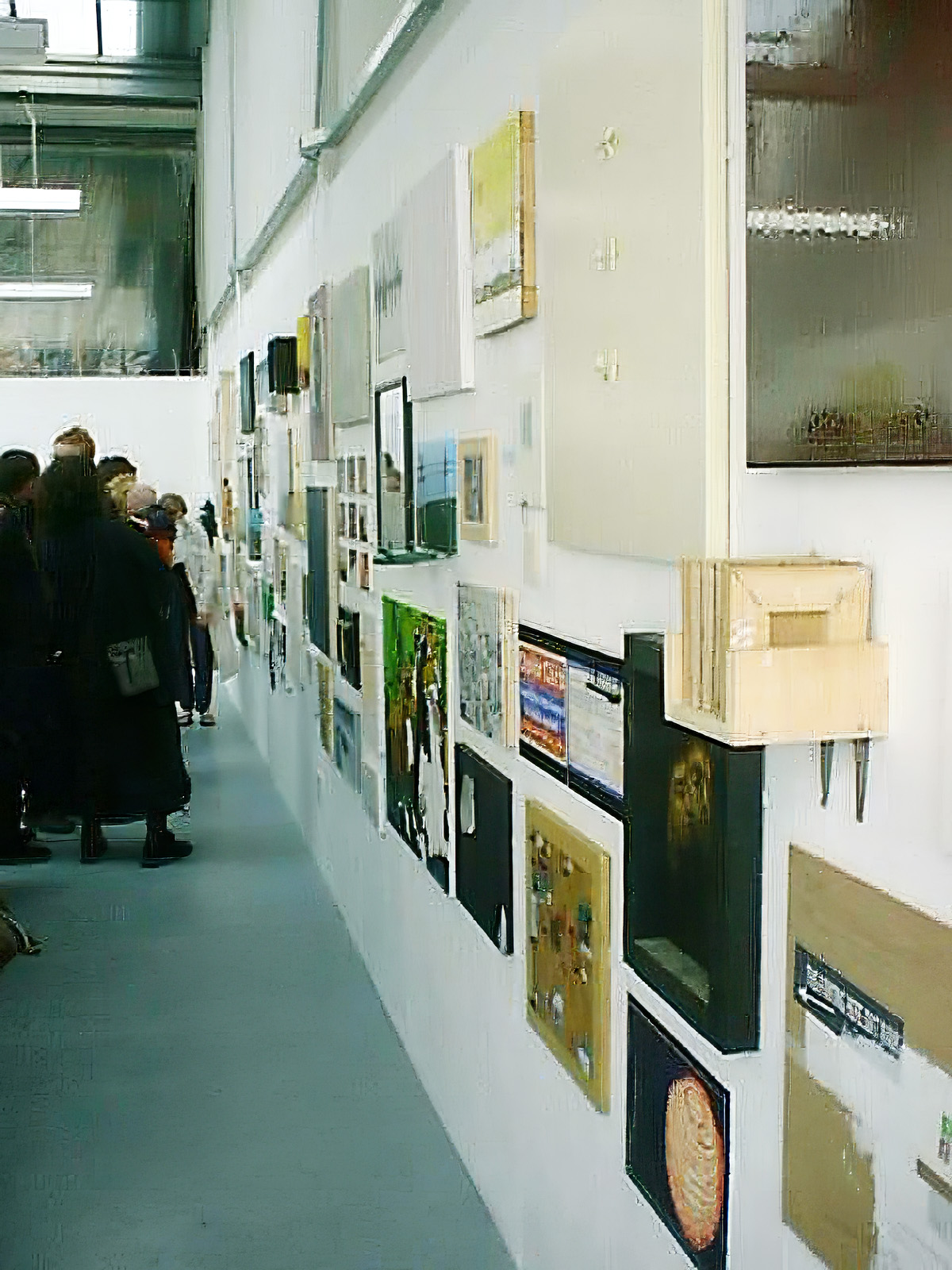
In the spring of 2000, Vim & Vigour brought together more than eighty artists at S1 Artspace, Sheffield, in an ambitious exhibition exploring the continued relevance of painting at the turn of the millennium. Curated by MASS — Ben Jones, Melanie Jordan and Sean Williams — the exhibition deliberately placed painters alongside artists working in photography, video, installation and sculpture, presenting painting not as an isolated discipline but as part of a wider contemporary conversation.
Rather than attempting to define a single position, Vim & Vigour embraced the diversity of contemporary practice. Established artists exhibited alongside recent graduates, while the accompanying catalogue brought together essays, artists’ writings and visual projects reflecting the debates surrounding painting at the beginning of the twenty-first century. Questions concerning representation, materiality and the future of painting run throughout the publication, capturing a moment when the medium was once again being challenged, defended and redefined.
Richard Bartle exhibited A Hole in the Ground (2000), a painting from his Repetitions series. Made using acrylic, coal and laser image transfers on canvas, the work explored the relationship between landscape, industry and the material beneath our feet. Produced during a period when his practice investigated mining landscapes, oil, extraction and the cultural value of the ground itself, the painting also played on the dual meaning of its title: ground as both the earth below us and the prepared surface upon which a painting is made.
More than twenty-five years later, Vim & Vigour remains a valuable document of British painting at the turn of the millennium. The exhibition and its accompanying publication record a generation of artists engaged in a lively debate about the place of painting within contemporary art. Reproduced here as a complete digital edition, it preserves that discussion while providing an accessible historical record of the exhibition and the artists who took part.
Original Invitation
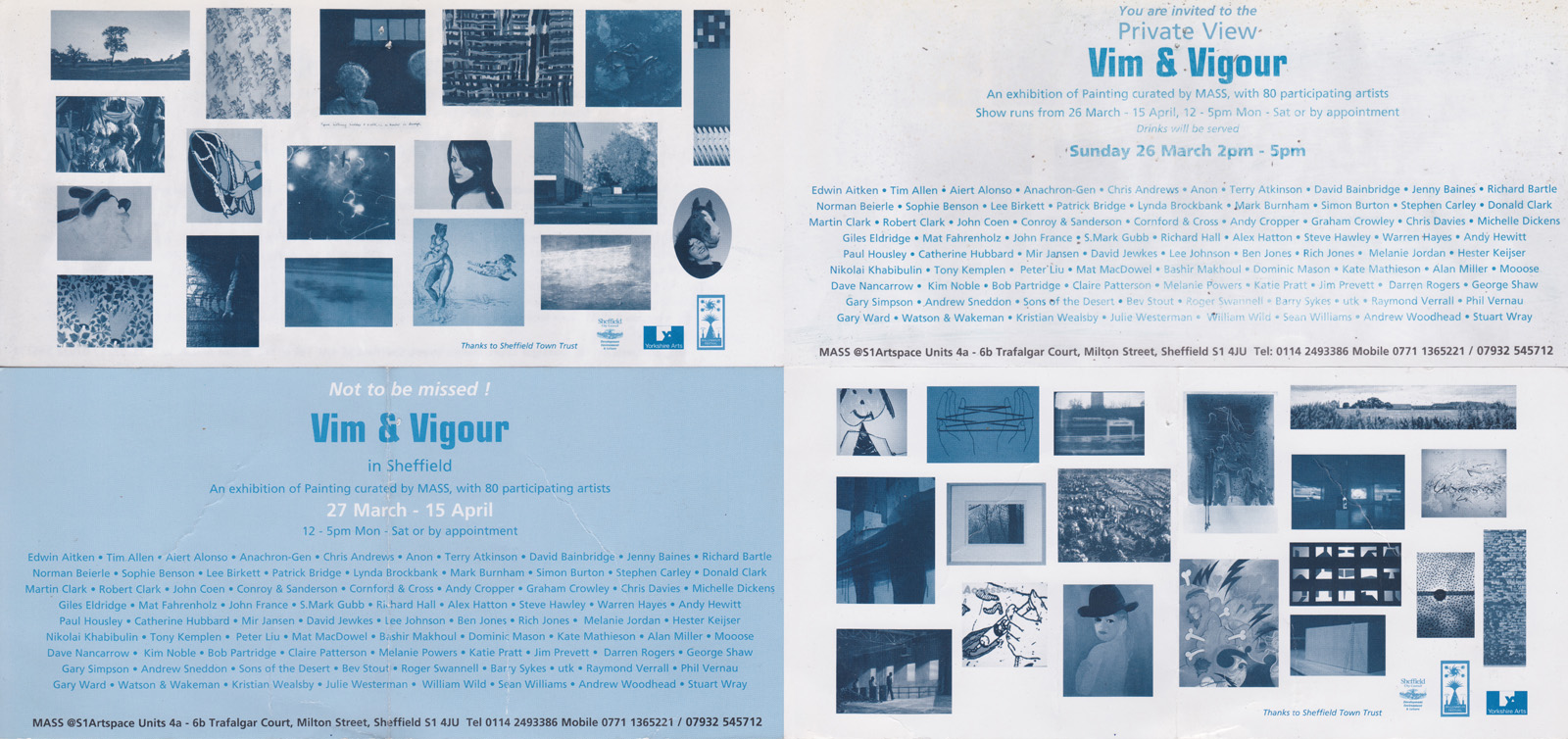
Original exhibition invitation
Designed using details from works by participating artists, the invitation reflected the diversity of approaches represented within Vim & Vigour. More than a piece of publicity, it offered visitors their first encounter with the exhibition before they entered the gallery.
Private View: Sunday 26 March 2000, 2.00–5.00 pm
Exhibition: 27 March – 15 April 2000
Opening hours: 12.00–5.00 pm, Monday–Saturday, or by appointment
Participating Artists
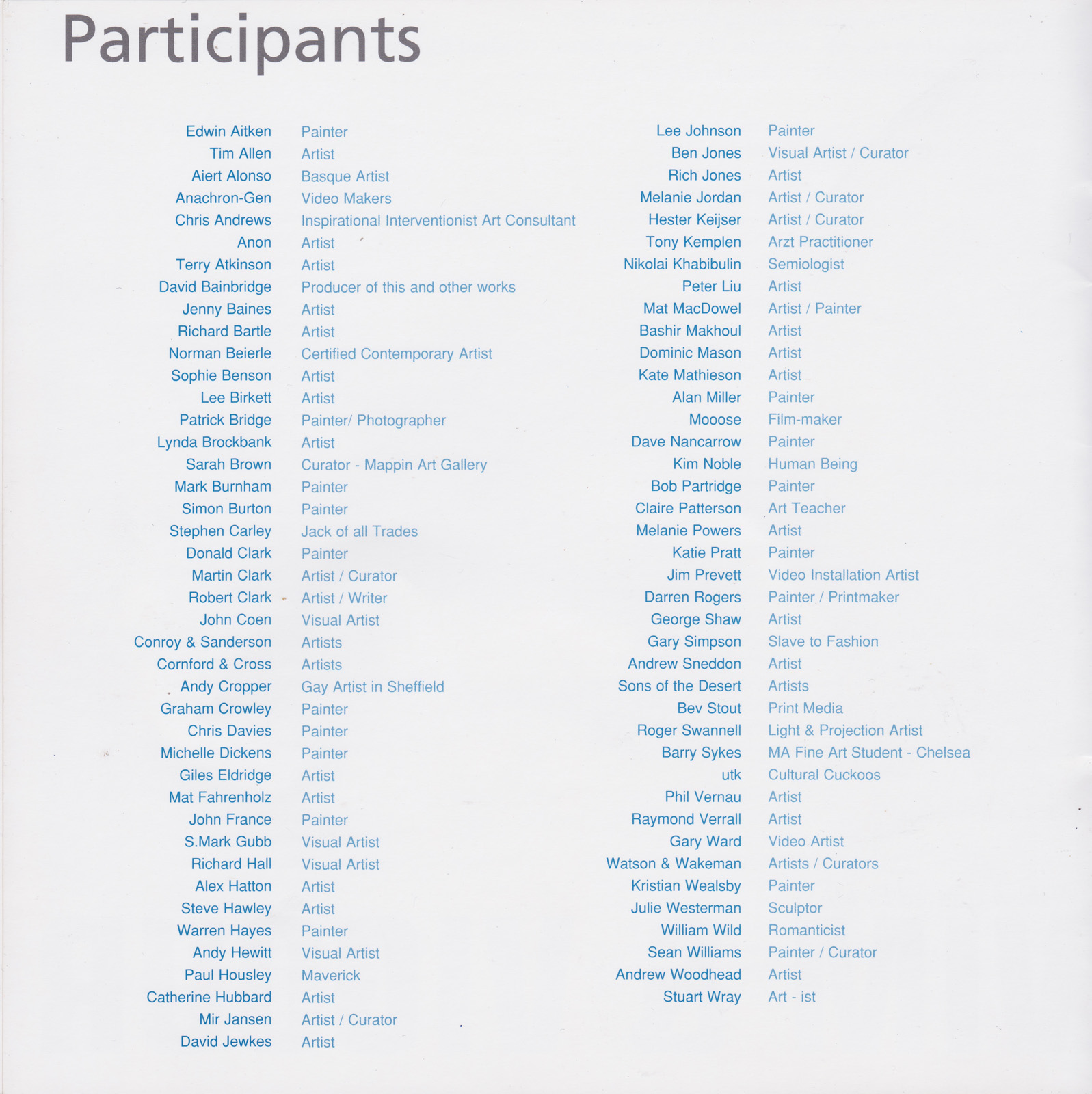
More than eighty artists participated in Vim & Vigour. The complete list, including the artists’ original self-descriptions, is preserved in the catalogue transcript below.
Curated by MASS — Ben Jones, Melanie Jordan and Sean Williams.
Artwork
Richard Bartle exhibited A Hole in the Ground (2000), a painting from the Repetitions series.
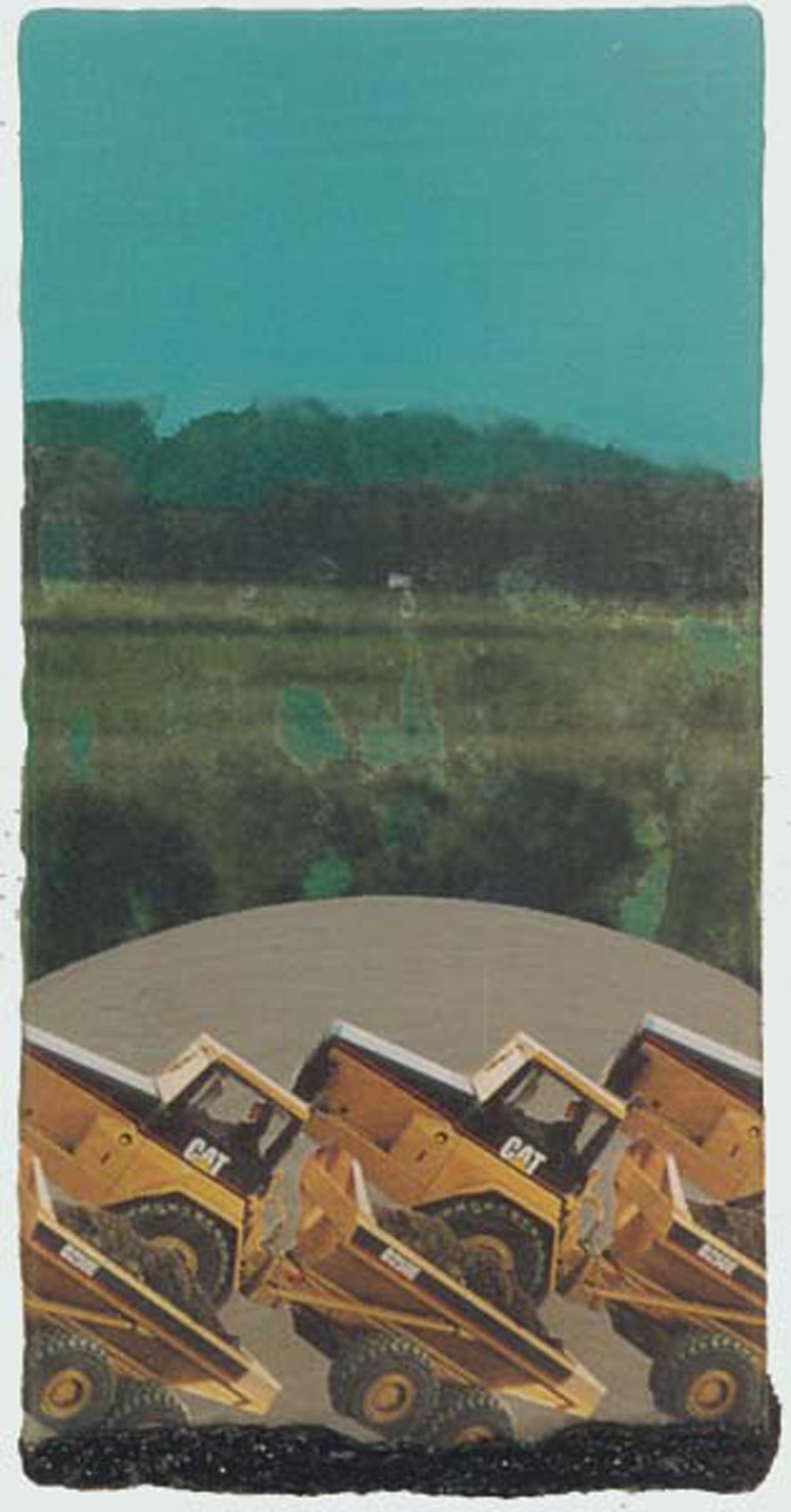
A Hole in the Ground
2000 · acrylic, coal and laser images on canvas · 25 × 12.5 cm
From Repetitions
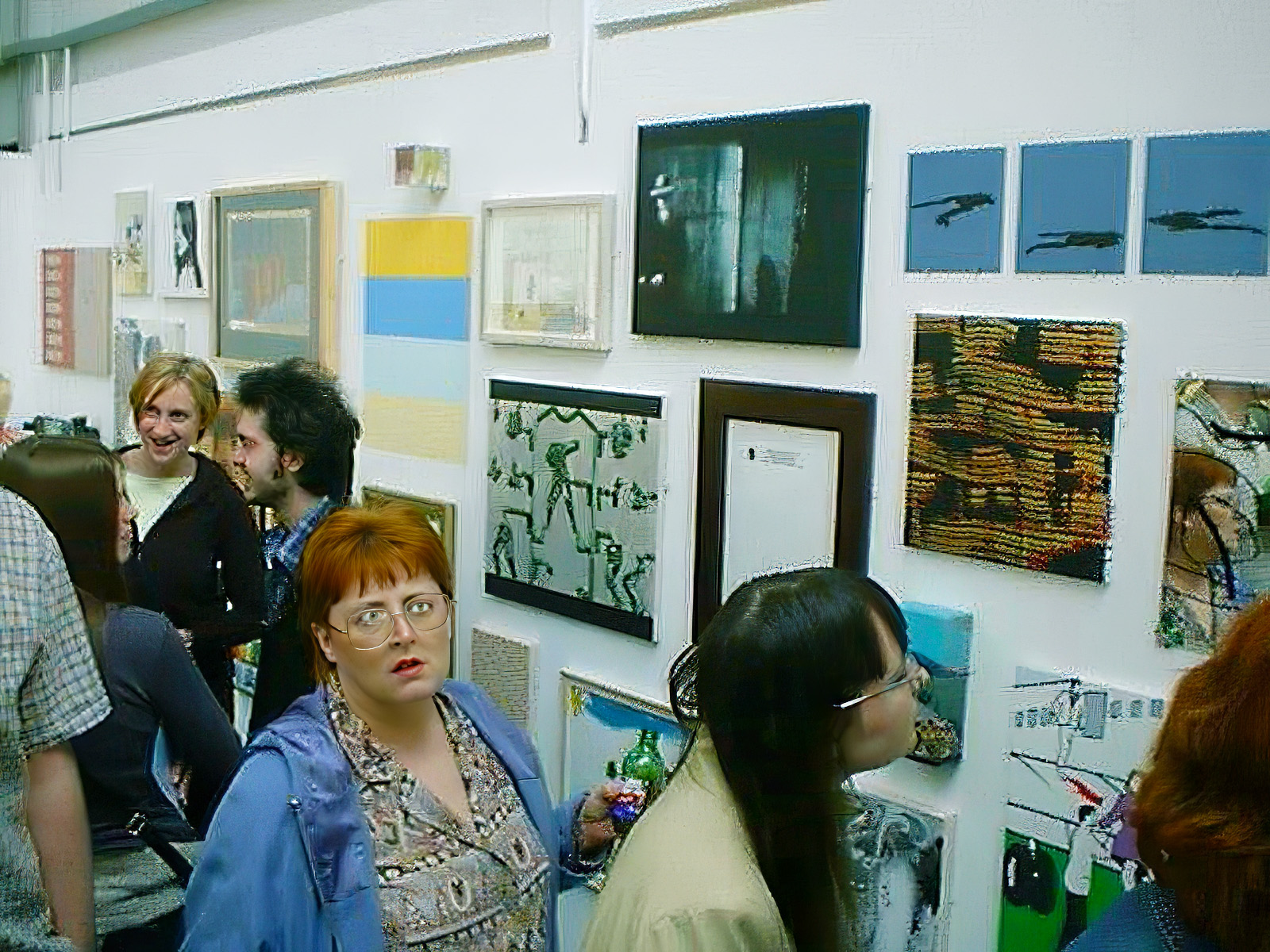
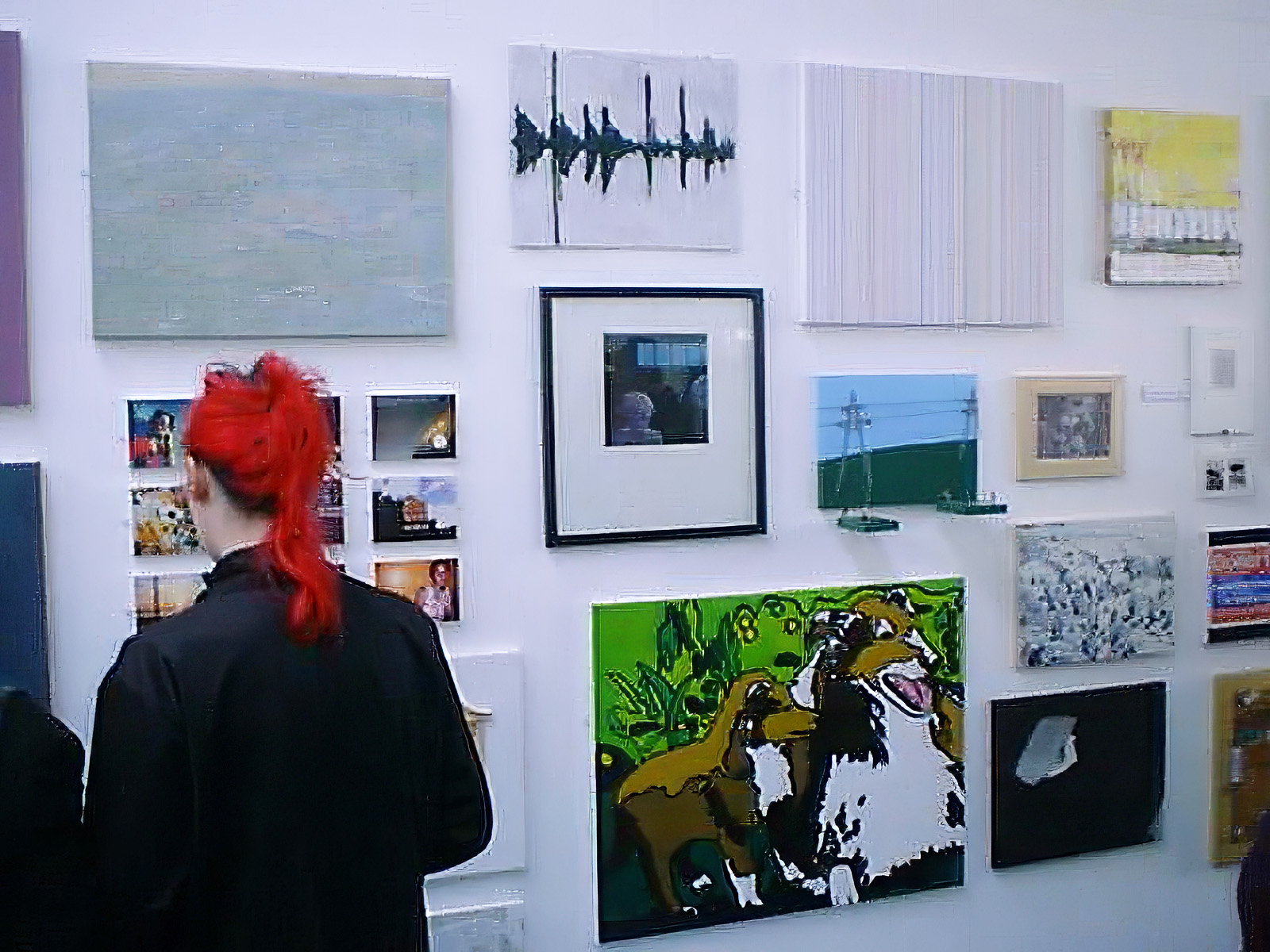
Installation Views
Catalogue
Vim & Vigour
Published to accompany the exhibition Vim & Vigour, presented at S1 Artspace, Sheffield, from 26 March to 15 April 2000.
The original Vim & Vigour catalogue is reproduced below as a complete digital edition. Each page is presented alongside a transcript to preserve the original publication while improving accessibility and searchability.
Catalogue Front Cover
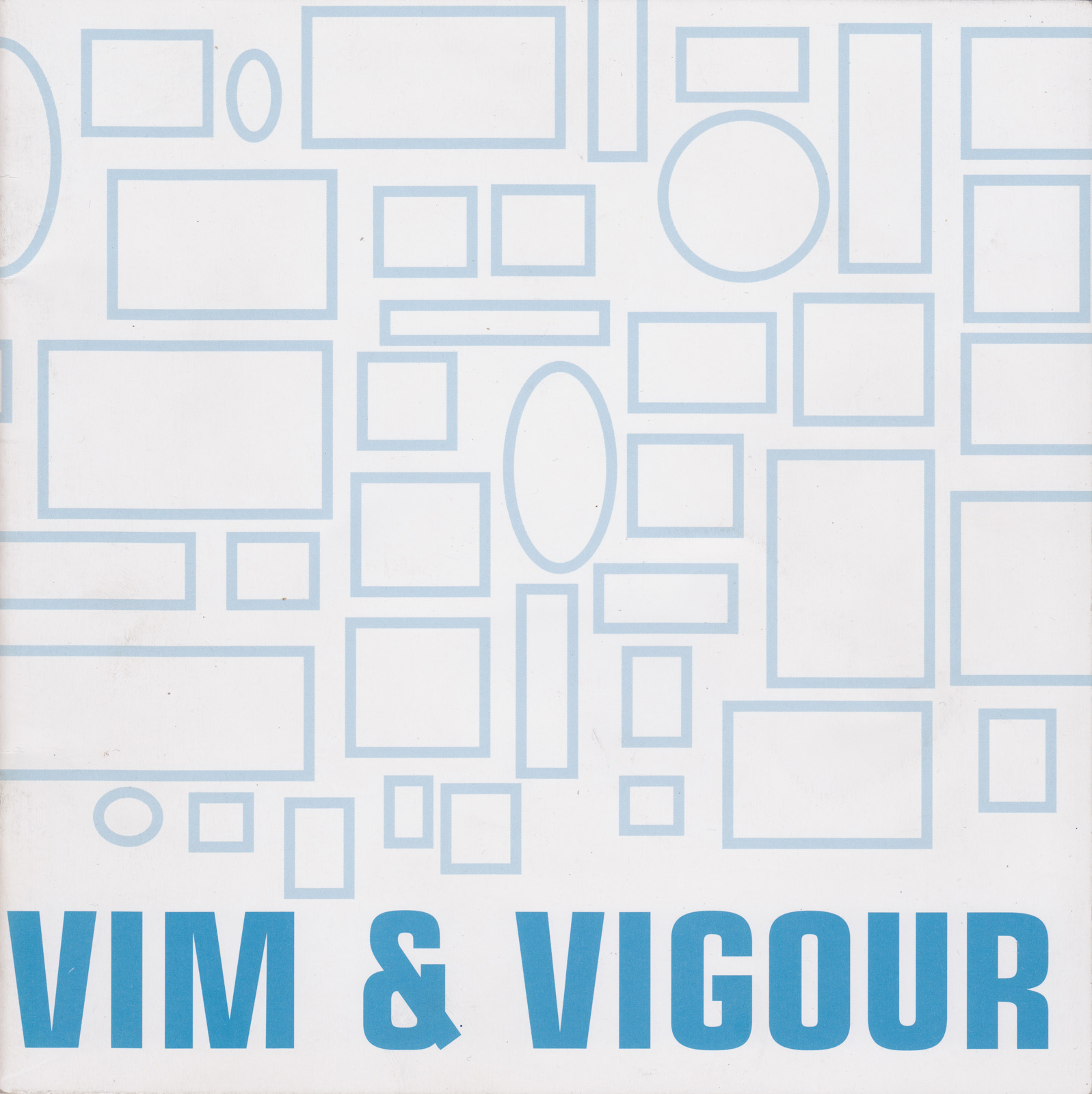
Catalogue front cover
Opening Page
Catalogue opening page
Vim & Vigour – an exhibition of painting curated by MASS
S1 Artspace, Units 4a–6b, Trafalgar Court, Milton Street, Sheffield S1 4JU
Participants
Catalogue page 3 · Participants
Foreword
Sarah Brown
Catalogue page 4 · Foreword by Sarah Brown
Today artists have an unprecedented freedom – they can make works of art from anything. What is the place of the practice of painting in this myriad of opportunities? As the oldest and most renowned tradition of making art where is its place as we enter the next century?
Like a cat with nine lives painting has repeatedly been declared dead and yet continued to live. With the arrival of photography its purpose was undermined. Why does the application of paint to a surface still continue today despite everything else that is available for artists to work with? Why do artists still choose to paint? Why do artists choose to become painters?
Painting has undergone much discussion – figurative versus abstraction – observation versus fabrication – and the discussion has developed from within painting to a more substantial discussion about the practice of art. This exhibition presents painting not in opposition, but in relation to other contemporary art forms, like sculpture, photography, installation, video and film. The influences of painting on these media cannot be underestimated.
The continuing significance of the painting tradition can be seen in the selection of work in this exhibition. The wide range of painting is presented not as an analytical survey or analysis of recent painting but as an open-ended view of painting today.
For artists to meet and debate is valuable to their practice. Just as academia needs to have a visual presence to set alongside the seductive power of the written argument, research and experimentation are critical activities for any creative discipline and it is vital that an establishment dedicated to providing such opportunities should provide them to practising artists.
Sarah Brown is the Assistant Curator of Contemporary Art at the Mappin Art Gallery, Sheffield.
Catalogue Artwork
Catalogue page 5
Introduction
MASS
Catalogue page 6 · Introduction by MASS
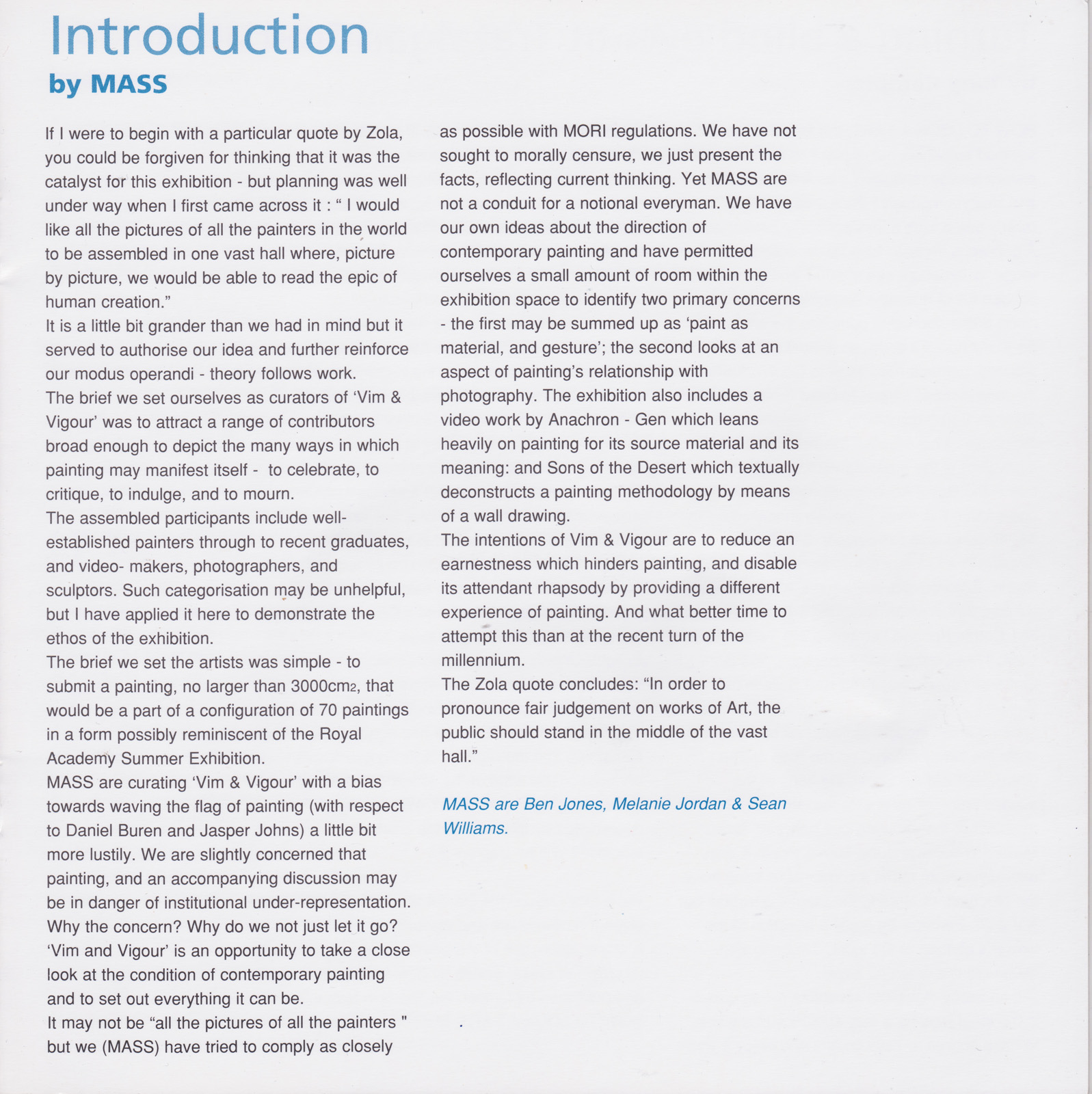
If I were to begin with a particular quote by Zola, you could be forgiven for thinking that it was the catalyst for this exhibition – but planning was well under way when I first came across it: “I would like all the pictures of all the painters in the world to be assembled in one vast hall where, picture by picture, we would be able to read the epic of human creation.”
It is a little bit grander than we had in mind but it served to authorise our idea and further reinforce our modus operandi – theory follows work.
The brief we set ourselves as curators of Vim & Vigour was to attract a range of contributors broad enough to depict the many ways in which painting may manifest itself – to celebrate, to critique, to indulge, and to mourn.
The assembled participants include well-established painters through to recent graduates, and video-makers, photographers, and sculptors. Such categorisation may be unhelpful, but I have applied it here to demonstrate the ethos of the exhibition.
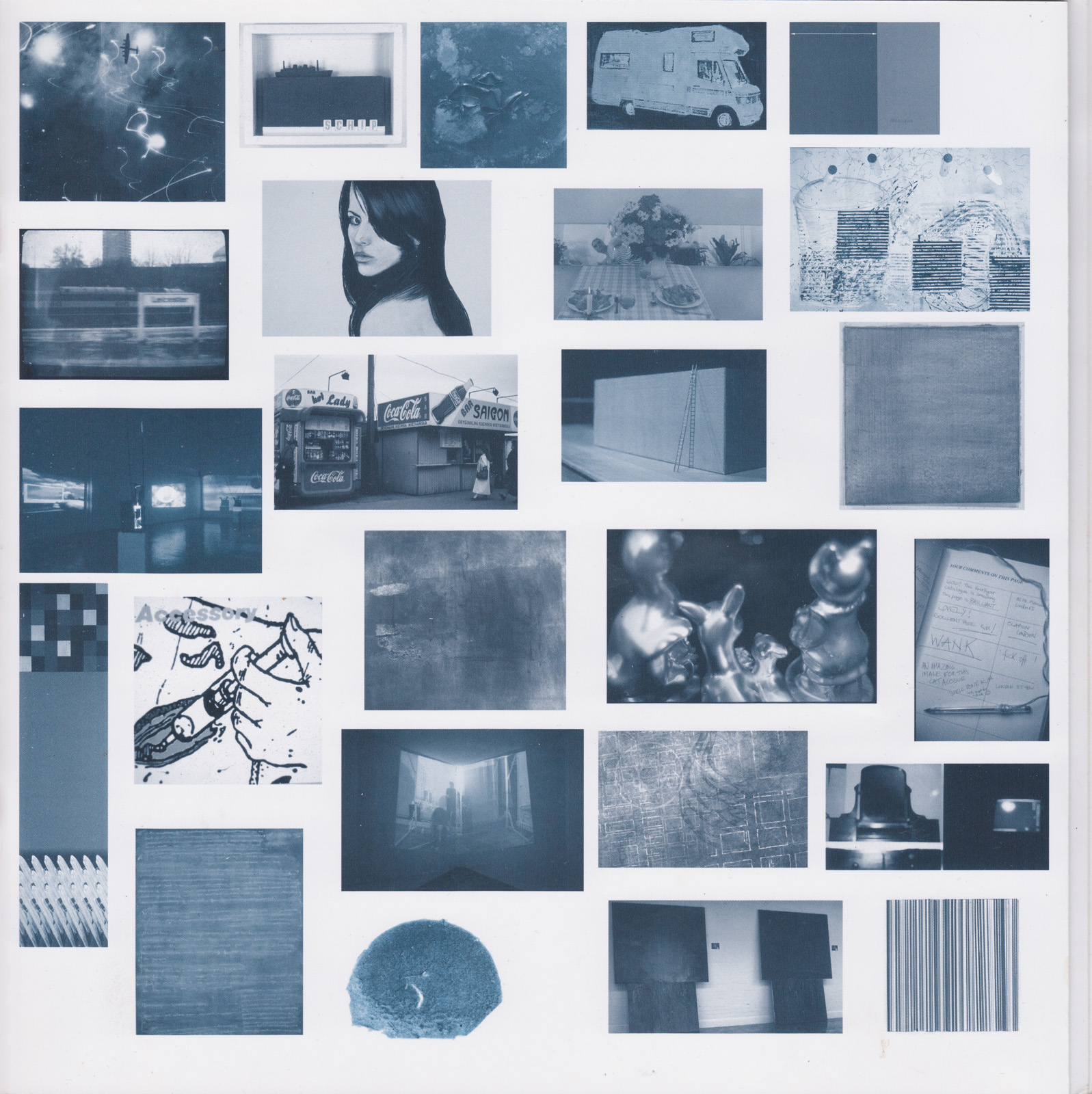
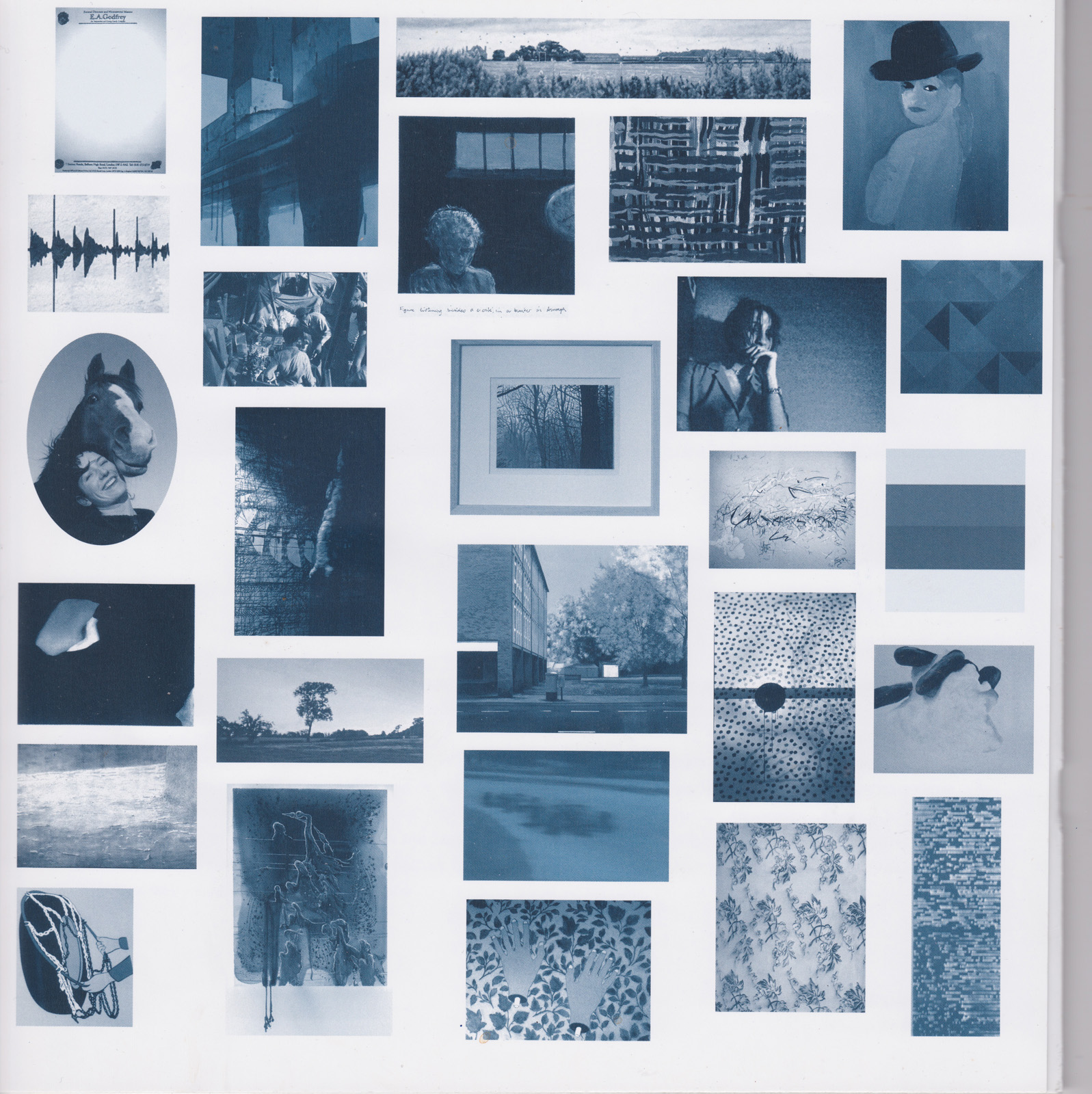
The brief we set the artists was simple – to submit a painting, no larger than 3000cm², that would be a part of a configuration of 70 paintings in a form possibly reminiscent of the Royal Academy Summer Exhibition.
MASS are curating Vim & Vigour with a bias towards waving the flag of painting (with respect to Daniel Buren and Jasper Johns) a little bit more lustily. We are slightly concerned that painting, and an accompanying discussion may be in danger of institutional under-representation.
Why the concern? Why do we not just let it go?
Vim & Vigour is an opportunity to take a close look at the condition of contemporary painting and to set out everything it can be.
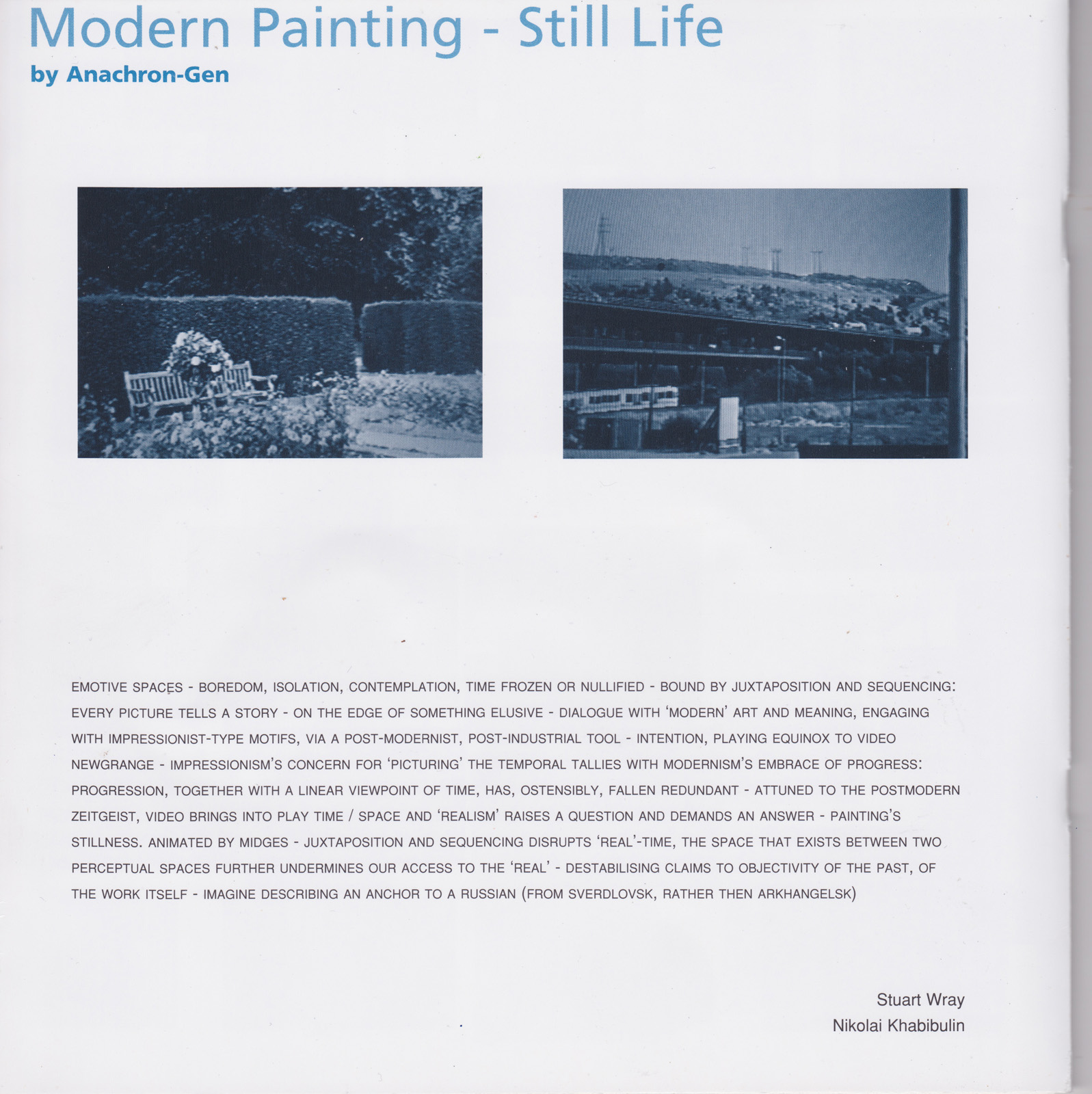
It may not be “all the pictures of all the painters” but we (MASS) have tried to comply as closely as possible with MORI regulations. We have not sought to morally censure, we just present the facts, reflecting current thinking. Yet MASS are not a conduit for a notional everyman. We have our own ideas about the direction of contemporary painting and have permitted ourselves a small amount of room within the exhibition space to identify two primary concerns – the first may be summed up as ‘paint as material, and gesture’; the second looks at an aspect of painting’s relationship with photography. The exhibition also includes a video work by Anachron-Gen which leans heavily on painting for its source material and its meaning; and Sons of the Desert which textually deconstructs a painting methodology by means of a wall drawing.
The intentions of Vim & Vigour are to reduce an earnestness which hinders painting, and disable its attendant rhapsody by providing a different experience of painting. And what better time to attempt this than at the recent turn of the millennium.
The Zola quote concludes: “In order to pronounce fair judgement on works of Art, the public should stand in the middle of the vast hall.”
MASS are Ben Jones, Melanie Jordan & Sean Williams.
Turning a Blind Eye at Trafalgar Court
Tony Kemplen
Catalogue page 7 · Turning a Blind Eye at Trafalgar Court
Turning a blind eye¹ at Trafalgar Court²
Tony Kemplen
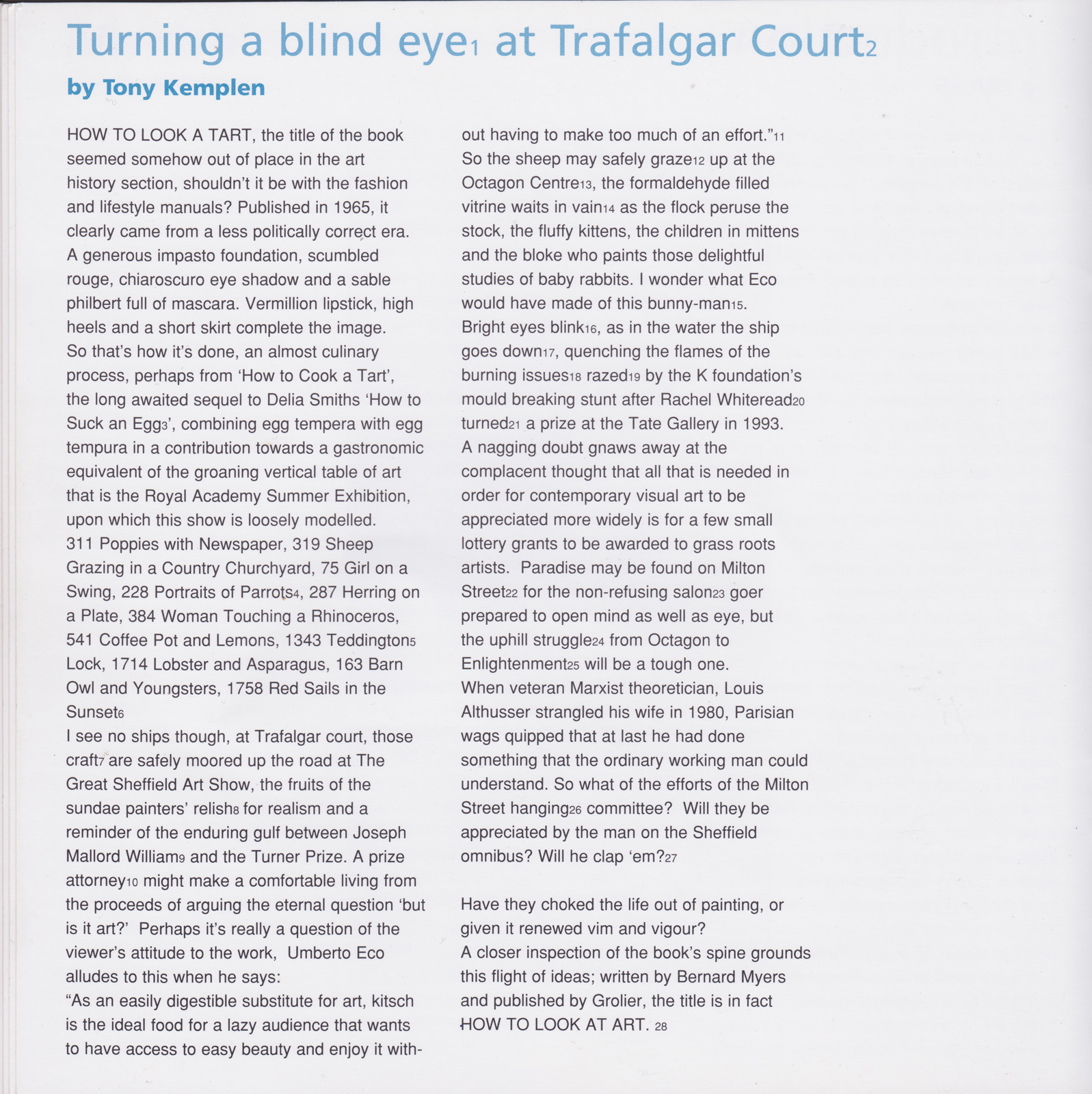
HOW TO LOOK A TART, the title of the book seemed somehow out of place in the art history section, shouldn’t it be with the fashion and lifestyle manuals? Published in 1965, it clearly came from a less politically correct era. A generous impasto foundation, scumbled rouge, chiaroscuro eye shadow and a sable philbert full of mascara. Vermillion lipstick, high heels and a short skirt complete the image.
So that’s how it’s done, an almost culinary process, perhaps from ‘How to Cook a Tart’, the long awaited sequel to Delia Smiths ‘How to Suck an Egg’³, combining egg tempera with egg tempura in a contribution towards a gastronomic equivalent of the groaning vertical table of art that is the Royal Academy Summer Exhibition, upon which this show is loosely modelled.
311 Poppies with Newspaper, 319 Sheep Grazing in a Country Churchyard, 75 Girl on a Swing, 228 Portraits of Parrots⁴, 287 Herring on a Plate, 384 Woman Touching a Rhinoceros, 541 Coffee Pot and Lemons, 1343 Teddington⁵ Lock, 1714 Lobster and Asparagus, 163 Barn Owl and Youngsters, 1758 Red Sails in the Sunset⁶
I see no ships though, at Trafalgar Court, those craft⁷ are safely moored up the road at The Great Sheffield Art Show, the fruits of the Sunday painters’ relish⁸ for realism and a reminder of the enduring gulf between Joseph Mallord William⁹ and the Turner Prize. A prize attorney¹⁰ might make a comfortable living from the proceeds of arguing the eternal question ‘but is it art?’ Perhaps it’s really a question of the viewer’s attitude to the work, Umberto Eco alludes to this when he says:
“As an easily digestible substitute for art, kitsch is the ideal food for a lazy audience that wants to have access to easy beauty and enjoy it without having to make too much of an effort.”¹¹
So the sheep may safely graze¹² up at the Octagon Centre¹³, the formaldehyde filled vitrine waits in vain¹⁴ as the flock peruse the stock, the fluffy kittens, the children in mittens and the bloke who paints those delightful studies of baby rabbits. I wonder what Eco would have made of this bunny-man¹⁵.
Bright eyes blink¹⁶, as in the water the ship goes down¹⁷, quenching the flames of the burning issues¹⁸ razed¹⁹ by the K foundation’s mould breaking stunt after Rachel Whiteread²⁰ turned²¹ a prize at the Tate Gallery in 1993.
A nagging doubt gnaws away at the complacent thought that all that is needed in order for contemporary visual art to be appreciated more widely is for a few small lottery grants to be awarded to grass roots artists. Paradise may be found on Milton Street²² for the non-refusing salon²³ goer prepared to open mind as well as eye, but the uphill struggle²⁴ from Octagon to Enlightenment²⁵ will be a tough one.
When veteran Marxist theoretician, Louis Althusser strangled his wife in 1980, Parisian wags quipped that at last he had done something that the ordinary working man could understand. So what of the efforts of the Milton Street hanging²⁶ committee? Will they be appreciated by the man on the Sheffield omnibus? Will he clap ‘em?²⁷
Have they choked the life out of painting, or given it renewed vim and vigour?
A closer inspection of the book’s spine grounds this flight of ideas; written by Bernard Myers and published by Grolier, the title is in fact HOW TO LOOK AT ART.²⁸
Catalogue page 8 · Notes
Turning a blind eye¹ at Trafalgar Court²
Tony Kemplen
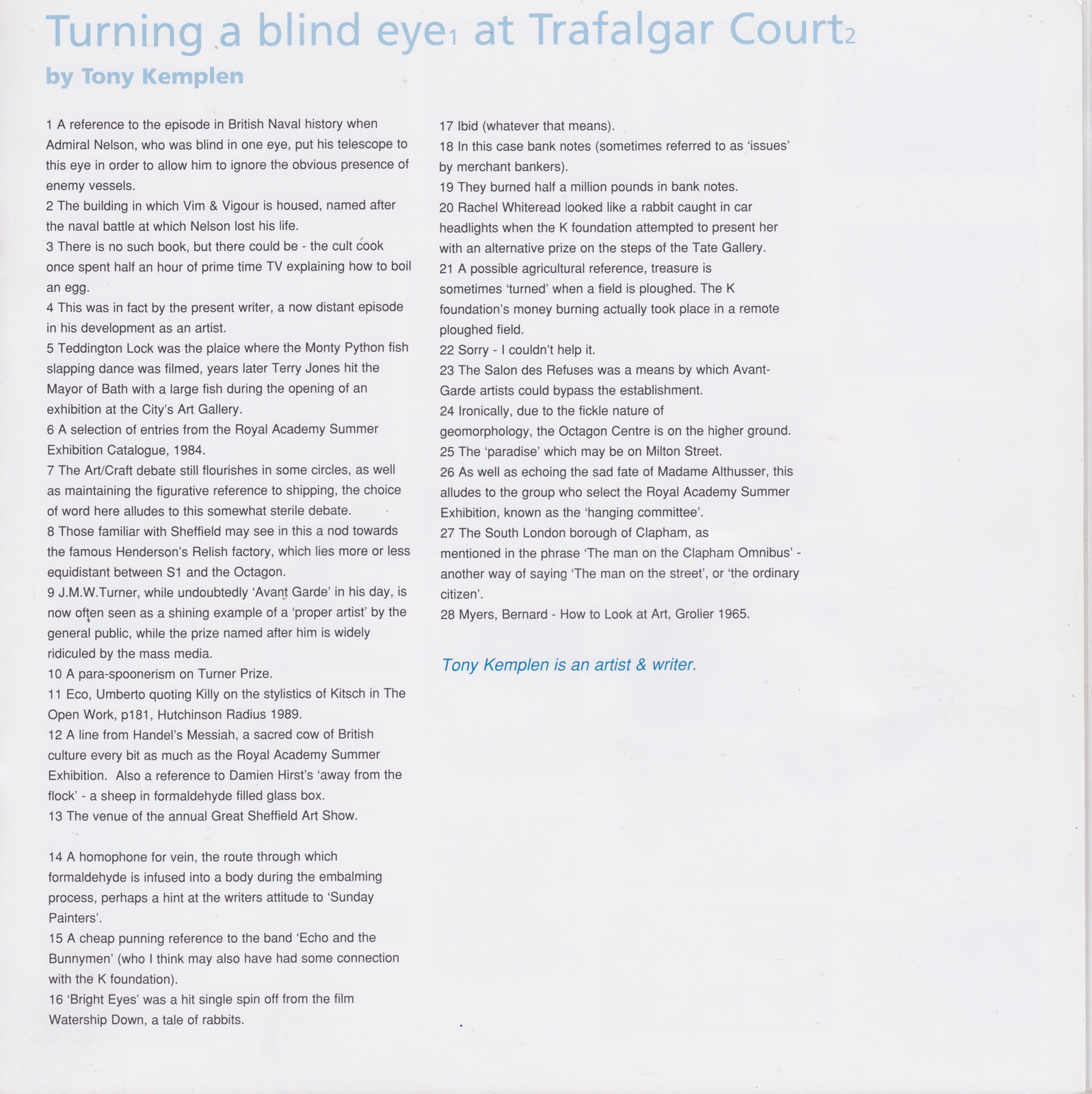
1 A reference to the episode in British Naval history when Admiral Nelson, who was blind in one eye, put his telescope to this eye in order to allow him to ignore the obvious presence of enemy vessels.
2 The building in which Vim & Vigour is housed, named after the naval battle at which Nelson lost his life.
3 There is no such book, but there could be – the cult cook once spent half an hour of prime time TV explaining how to boil an egg.
4 This was in fact by the present writer, a now distant episode in his development as an artist.
5 Teddington Lock was the place where the Monty Python fish slapping dance was filmed, years later Terry Jones hit the Mayor of Bath with a large fish during the opening of an exhibition at the City’s Art Gallery.
6 A selection of entries from the Royal Academy Summer Exhibition Catalogue, 1984.
7 The Art/Craft debate still flourishes in some circles, as well as maintaining the figurative reference to shipping, the choice of word here alludes to this somewhat sterile debate.
8 Those familiar with Sheffield may see in this a nod towards the famous Henderson’s Relish factory, which lies more or less equidistant between S1 and the Octagon.
9 J.M.W. Turner, while undoubtedly ‘Avant Garde’ in his day, is now often seen as a shining example of a ‘proper artist’ by the general public, while the prize named after him is widely ridiculed by the mass media.
10 A para-spoonerism on Turner Prize.
11 Eco, Umberto quoting Killy on the stylistics of Kitsch in The Open Work, p181, Hutchinson Radius 1989.
12 A line from Handel’s Messiah, a sacred cow of British culture every bit as much as the Royal Academy Summer Exhibition. Also a reference to Damien Hirst’s Away from the Flock – a sheep in formaldehyde filled glass box.
13 The venue of the annual Great Sheffield Art Show.
14 A homophone for vein, the route through which formaldehyde is infused into a body during the embalming process, perhaps a hint at the writer’s attitude to ‘Sunday Painters’.
15 A cheap punning reference to the band ‘Echo and the Bunnymen’ (who I think may also have had some connection with the K foundation).
16 ‘Bright Eyes’ was a hit single spin off from the film Watership Down, a tale of rabbits.
17 Ibid (whatever that means).
18 In this case bank notes (sometimes referred to as ‘issues’ by merchant bankers).
19 They burned half a million pounds in bank notes.
20 Rachel Whiteread looked like a rabbit caught in car headlights when the K foundation attempted to present her with an alternative prize on the steps of the Tate Gallery.
21 A possible agricultural reference, treasure is sometimes ‘turned’ when a field is ploughed. The K foundation’s money burning actually took place in a remote ploughed field.
22 Sorry – I couldn’t help it.
23 The Salon des Refuses was a means by which Avant-Garde artists could bypass the establishment.
24 Ironically, due to the fickle nature of geomorphology, the Octagon Centre is on the higher ground.
25 The ‘paradise’ which may be on Milton Street.
26 As well as echoing the sad fate of Madame Althusser, this alludes to the group who select the Royal Academy Summer Exhibition, known as the ‘hanging committee’.
27 The South London borough of Clapham, as mentioned in the phrase ‘The man on the Clapham Omnibus’ – another way of saying ‘The man on the street’, or ‘the ordinary citizen’.
28 Myers, Bernard – How to Look at Art, Grolier 1965.
Tony Kemplen is an artist & writer.
Catalogue Artworks
Catalogue page 9
Catalogue page 10
Catalogue page 11
Modern Painting – Still Life
Anachron-Gen
Catalogue page 12 · Modern Painting – Still Life
Modern Painting – Still Life
Anachron-Gen
EMOTIVE SPACES – BOREDOM, ISOLATION, CONTEMPLATION, TIME FROZEN OR NULLIFIED – BOUND BY JUXTAPOSITION AND SEQUENCING:
EVERY PICTURE TELLS A STORY – ON THE EDGE OF SOMETHING ELUSIVE – DIALOGUE WITH ‘MODERN’ ART AND MEANING, ENGAGING WITH IMPRESSIONIST-TYPE MOTIFS, VIA A POST-MODERNIST, POST-INDUSTRIAL TOOL – INTENTION, PLAYING EQUIVOX TO VIDEO NEWGRANGE – IMPRESSIONISM’S CONCERN FOR ‘PICTURING’ THE TEMPORAL TALLIES WITH MODERNISM’S EMBRACE OF PROGRESS: PROGRESSION, TOGETHER WITH A LINEAR VIEWPOINT OF TIME, HAS, OSTENSIBLY, FALLEN REDUNDANT – ATTUNED TO THE POSTMODERN ZEITGEIST, VIDEO BRINGS INTO PLAY TIME / SPACE AND ‘REALISM’ RAISES A QUESTION AND DEMANDS AN ANSWER – PAINTING’S STILLNESS. ANIMATED BY MIDGES – JUXTAPOSITION AND SEQUENCING DISRUPTS ‘REAL’-TIME, THE SPACE THAT EXISTS BETWEEN TWO PERCEPTUAL SPACES FURTHER UNDERMINES OUR ACCESS TO THE ‘REAL’ – DESTABILISING CLAIMS TO OBJECTIVITY OF THE PAST, OF THE WORK ITSELF – IMAGINE DESCRIBING AN ANCHOR TO A RUSSIAN (FROM SVERDLOVSK, RATHER THEN ARKHANGELSK)
Stuart Wray
Nikolai Khabibulin
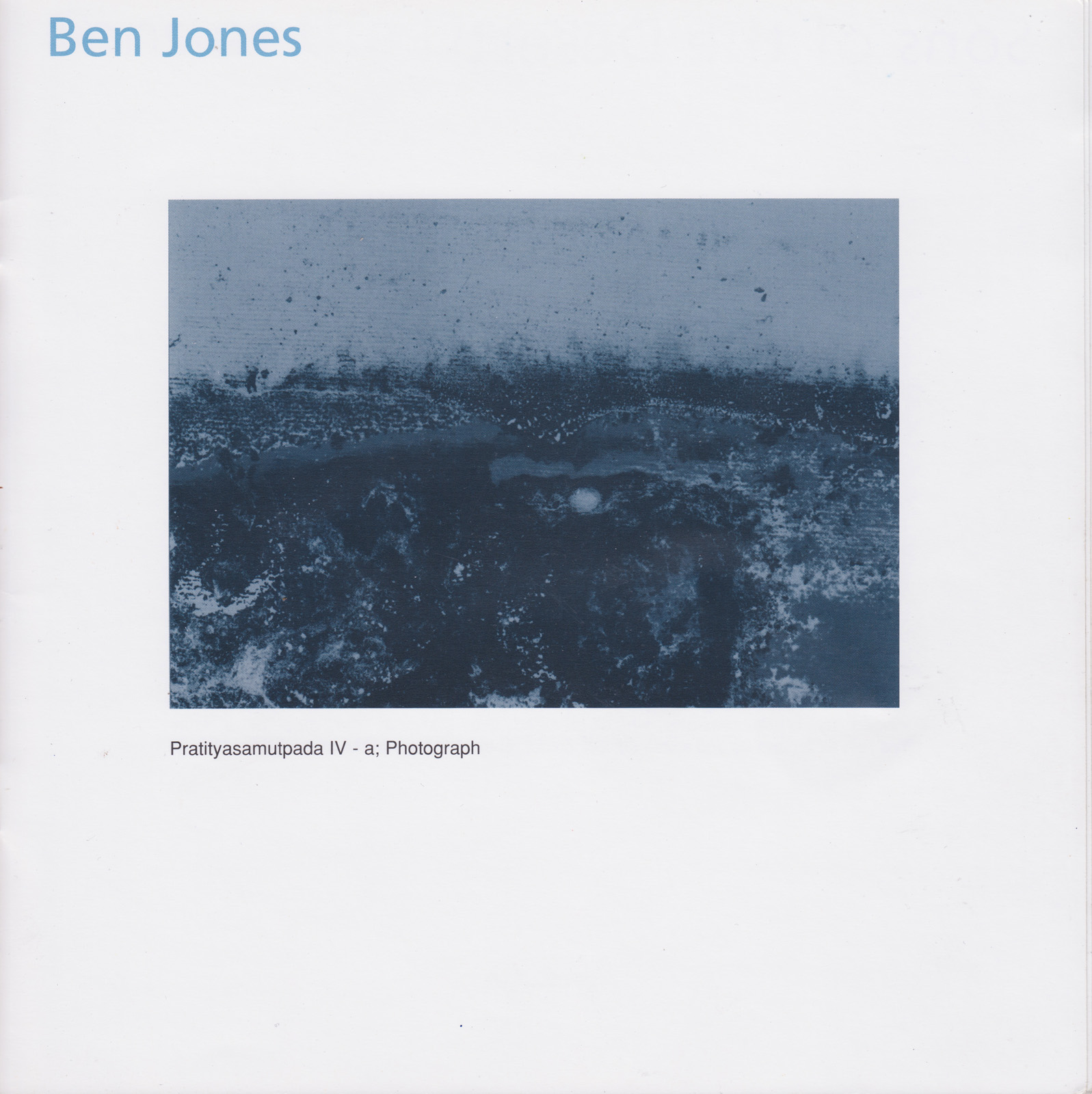
Pratityasamutpada IV
Ben Jones
Catalogue page 13 · Ben Jones, Pratityasamutpada IV – a · photograph
Sons of the Desert
Catalogue page 14 · fig 1. Event
Sons of the Desert
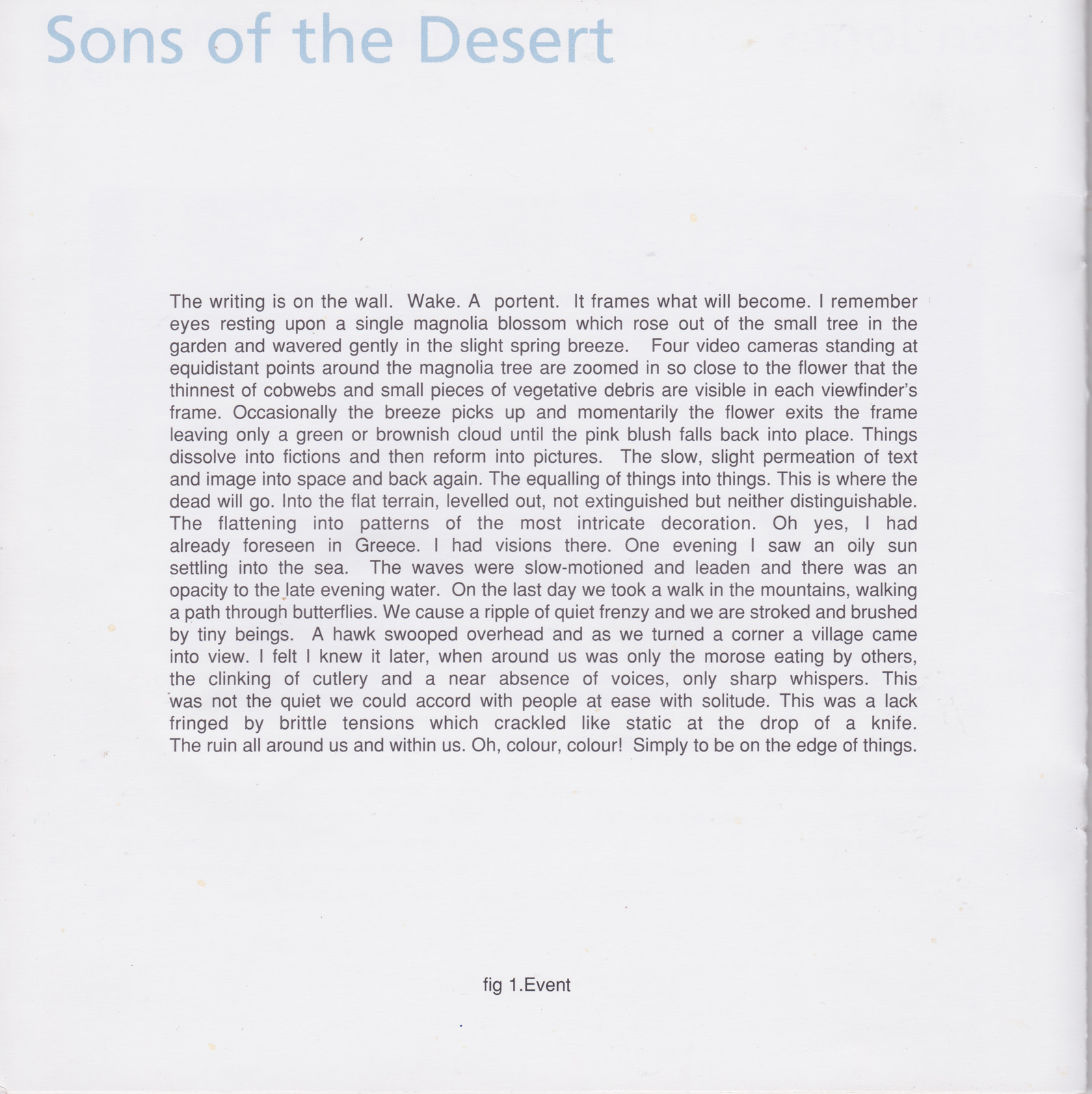
The writing is on the wall. Wake. A portent. It frames what will become. I remember eyes resting upon a single magnolia blossom which rose out of the small tree in the garden and wavered gently in the slight spring breeze. Four video cameras standing at equidistant points around the magnolia tree are zoomed in so close to the flower that the thinnest of cobwebs and small pieces of vegetative debris are visible in each viewfinder’s frame. Occasionally the breeze picks up and momentarily the flower exits the frame leaving only a green or brownish cloud until the pink blush falls back into place. Things dissolve into fictions and then reform into pictures. The slow, slight permeation of text and image into space and back again. The equalling of things into things. This is where the dead will go. Into the flat terrain, levelled out, not extinguished but neither distinguishable.
The flattening into patterns of the most intricate decoration. Oh yes, I had already foreseen in Greece. I had visions there. One evening I saw an oily sun settling into the sea. The waves were slow-motioned and leaden and there was an opacity to the late evening water. On the last day we took a walk in the mountains, walking a path through butterflies. We cause a ripple of quiet frenzy and we are stroked and brushed by tiny beings. A hawk swooped overhead and as we turned a corner a village came into view. I felt I knew it later, when around us was only the morose eating by others, the clinking of cutlery and a near absence of voices, only sharp whispers. This was not the quiet we could accord with people at ease with solitude. This was a lack fringed by brittle tensions which crackled like static at the drop of a knife. The ruin all around us and within us. Oh, colour, colour! Simply to be on the edge of things.
fig 1. Event
Catalogue page 15 · fig 2. Object
Sons of the Desert
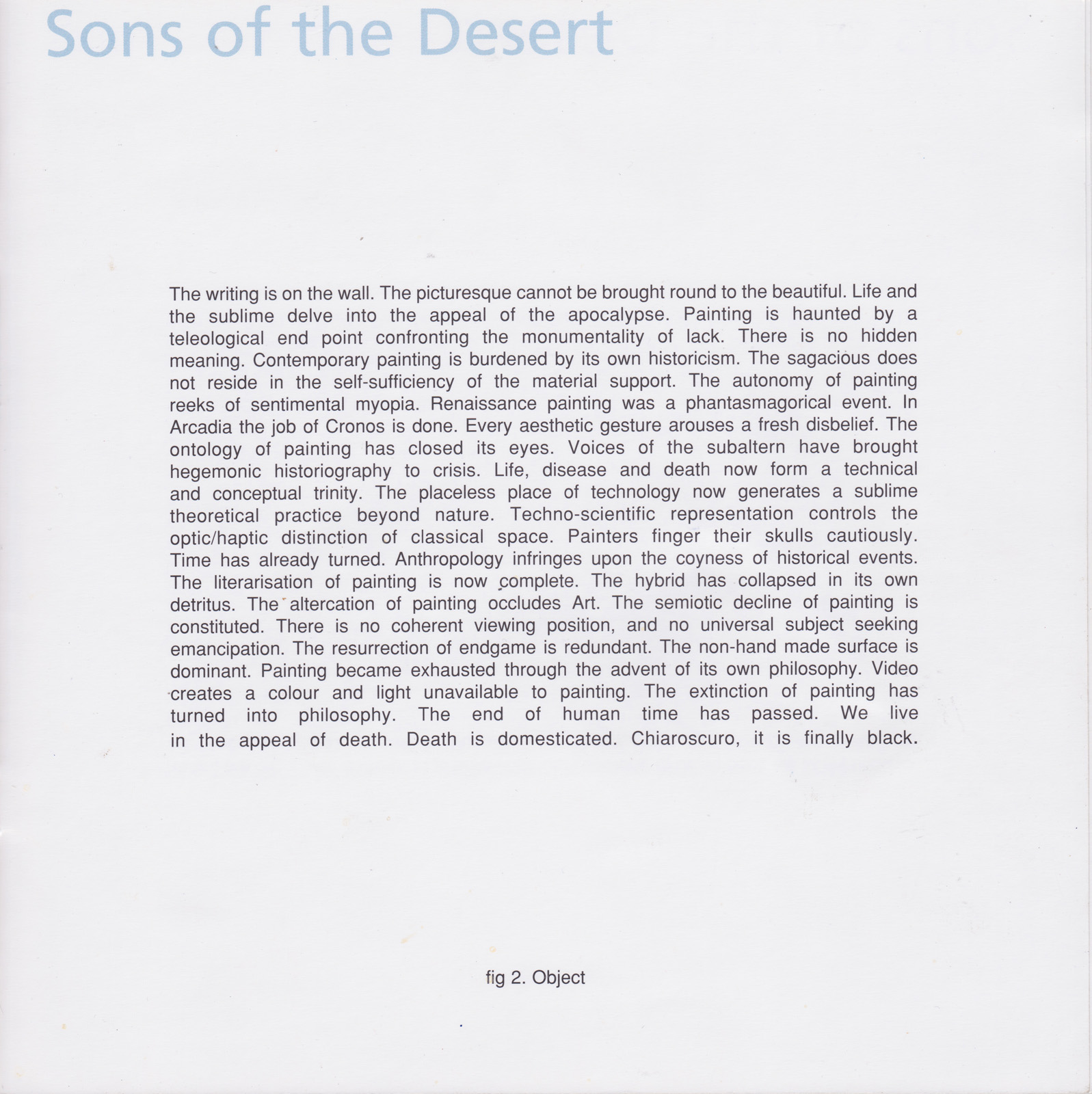
The writing is on the wall. The picturesque cannot be brought round to the beautiful. Life and the sublime delve into the appeal of the apocalypse. Painting is haunted by a teleological end point confronting the monumentality of lack. There is no hidden meaning. Contemporary painting is burdened by its own historicism. The sagacious does not reside in the self-sufficiency of the material support. The autonomy of painting reeks of sentimental myopia. Renaissance painting was a phantasmagorical event. In Arcadia the job of Cronos is done. Every aesthetic gesture arouses a fresh disbelief. The ontology of painting has closed its eyes. Voices of the subaltern have brought hegemonic historiography to crisis. Life, disease and death now form a technical and conceptual trinity. The placeless place of technology now generates a sublime theoretical practice beyond nature. Techno-scientific representation controls the optic/haptic distinction of classical space. Painters finger their skulls cautiously. Time has already turned. Anthropology infringes upon the coyness of historical events. The literalisation of painting is now complete. The hybrid has collapsed in its own detritus. The altercation of painting occludes Art. The semiotic decline of painting is constituted. There is no coherent viewing position, and no universal subject seeking emancipation. The resurrection of endgame is redundant. The non-hand made surface is dominant. Painting became exhausted through the advent of its own philosophy. Video creates a colour and light unavailable to painting. The extinction of painting has turned into philosophy. The end of human time has passed. We live in the appeal of death. Death is domesticated. Chiaroscuro, it is finally black.
fig 2. Object
Catalogue page 16 · fig 3. Object
Sons of the Desert
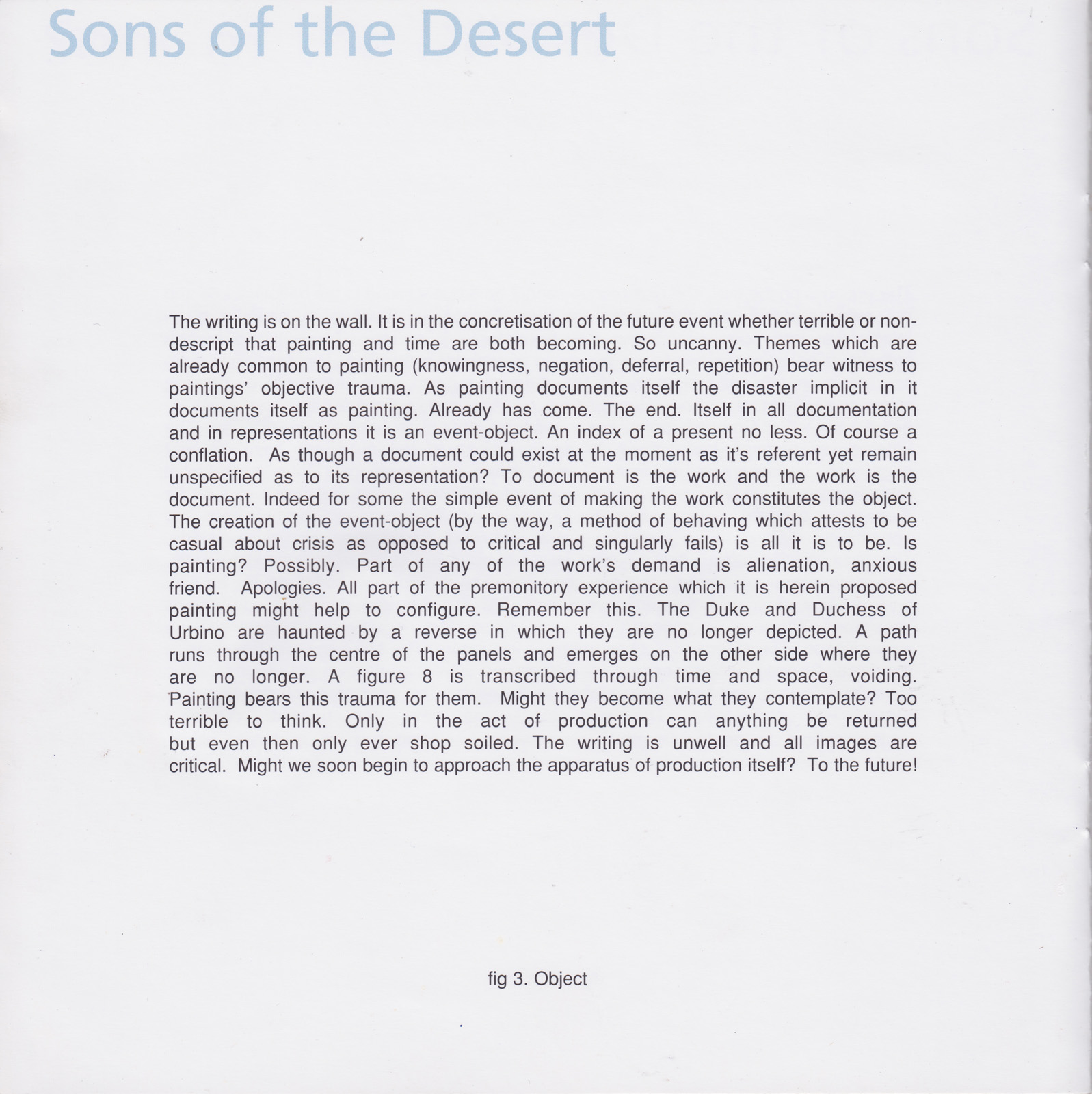
The writing is on the wall. It is in the concretisation of the future event whether terrible or non-descript that painting and time are both becoming. So uncanny. Themes which are already common to painting (knowingness, negation, deferral, repetition) bear witness to paintings’ objective trauma. As painting documents itself the disaster implicit in it documents itself as painting. Already has come. The end. Itself in all documentation and in representations it is an event-object. An index of a present no less. Of course a conflation. As though a document could exist at the moment as it’s referent yet remain unspecified as to its representation? To document is the work and the work is the document. Indeed for some the simple event of making the work constitutes the object.
The creation of the event-object (by the way, a method of behaving which attests to be casual about crisis as opposed to critical and singularly fails) is all it is to be. Is it painting? Possibly. Part of any of the work’s demand is alienation, anxious friend. Apologies. All part of the premonitory experience which it is herein proposed painting might help to configure. Remember this. The Duke and Duchess of Urbino are haunted by a reverse in which they are no longer depicted. A path runs through the centre of the panels and emerges on the other side where they are no longer. A figure 8 is transcribed through time and space, voiding. Painting bears this trauma for them. Might they become what they contemplate? Too terrible to think. Only in the act of production can anything be returned but even then only ever shop soiled. The writing is unwell and all images are critical. Might we soon begin to approach the apparatus of production itself? To the future!
fig 3. Object
Catalogue page 17 · fig 4. Event
Sons of the Desert
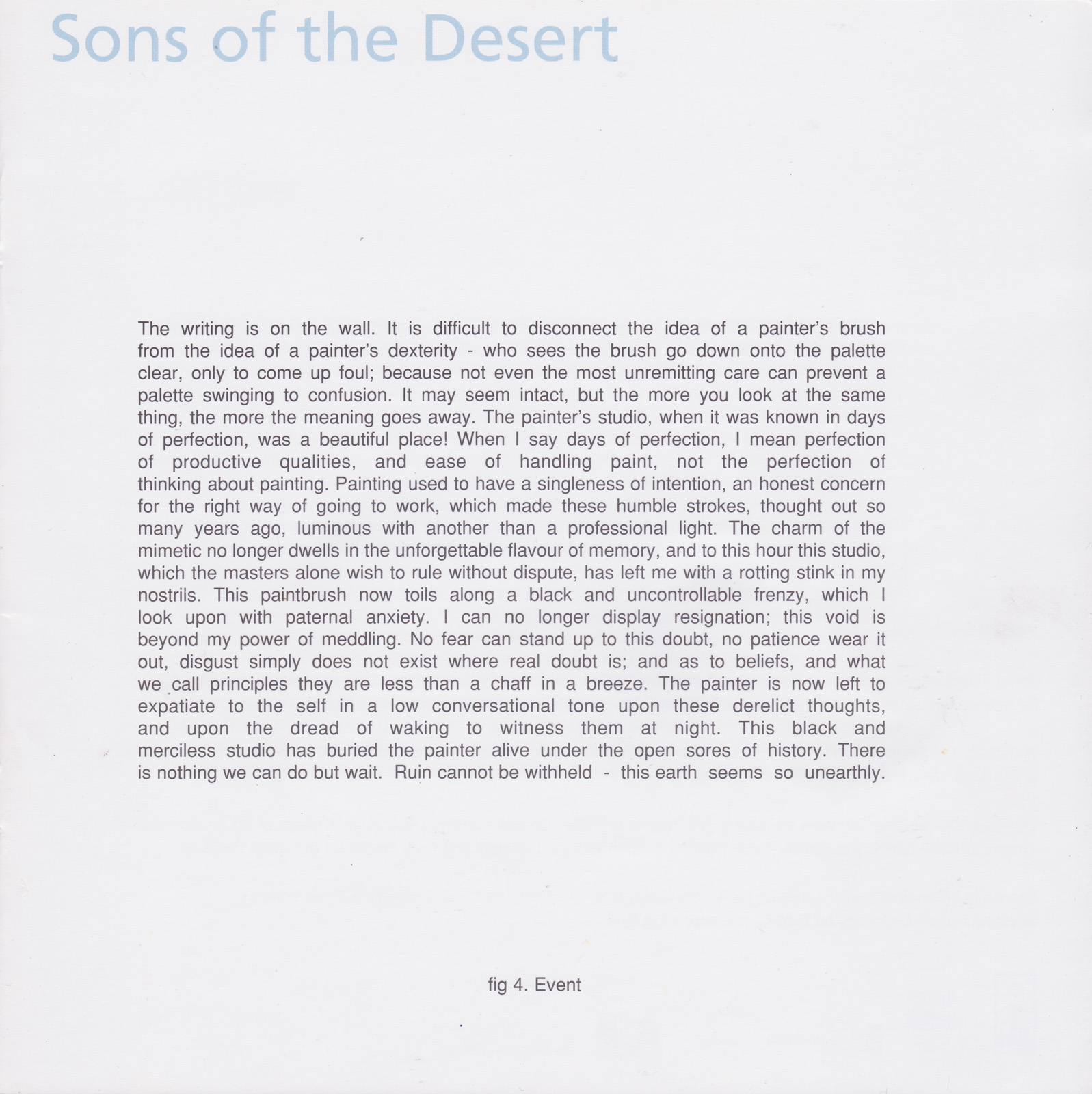
The writing is on the wall. It is difficult to disconnect the idea of a painter’s brush from the idea of a painter’s dexterity – who sees the brush go down onto the palette clear, only to come up foul; because not even the most unremitting care can prevent a palette swinging to confusion. It may seem intact, but the more you look at the same thing, the more the meaning goes away. The painter’s studio, when it was known in days of perfection, was a beautiful place! When I say days of perfection, I mean perfection of productive qualities, and ease of handling paint, not the perfection of thinking about painting. Painting used to have a singleness of intention, an honest concern for the right way of going to work, which made these humble strokes, thought out so many years ago, luminous with another than a professional light.
The charm of the mimetic no longer dwells in the unforgettable flavour of memory, and to this hour this studio, which the masters alone wish to rule without dispute, has left me with a rotting stink in my nostrils. This paintbrush now toils along a black and uncontrollable frenzy, which I look upon with paternal anxiety. I can no longer display resignation; this void is beyond my power of meddling. No fear can stand up to this doubt, no patience wear it out, disgust simply does not exist where real doubt is; and as to beliefs, and what we call principles they are less than a chaff in a breeze. The painter is now left to expatiate to the self in a low conversational tone upon these derelict thoughts, and upon the dread of waking to witness them at night. This black and merciless studio has buried the painter alive under the open sores of history. There is nothing we can do but wait. Ruin cannot be withheld – this earth seems so unearthly.
fig 4. Event
Acknowledgements
Catalogue page 18 · Acknowledgements
ISBN 0 863399045
With special thanks to Sarah Brown at the Mappin Art Gallery, Tony Kemplen, Anachron-Gen and Sons of the Desert for their contributions to this catalogue and the Vim & Vigour exhibition. With thanks to all participating artists.
With thanks to Karen Wood for brilliant administration support throughout the project. Thanks to David Ball and Simon Quinn of the Slide Library at Sheffield Hallam University.
Thanks to Dulcie Mae Reynders for mailing list. Thanks to Vicky Harrison, Painting Dept., Royal College of Art, for storing work. Thanks to Colin Smith, Site Gallery Technician, for support with photography and Andy Hewitt for exhibition hanging.
Thanks to Millennium Festival Awards for All, Yorkshire Arts, Sheffield City Council, Sheffield Town Trust & Sheffield Hallam University for funding and support in kind.
Catalogue Closing Page
Catalogue page 19
Legacy
Vim & Vigour remains an important record of painting and its surrounding debates at the turn of the millennium. By bringing together more than eighty artists working across different generations and approaches, the exhibition reflected both the continued vitality of painting and the uncertainty surrounding its position within contemporary art.
The exhibition also records a significant moment in Sheffield’s artist-led history. Staged at S1 Artspace and curated by MASS, it brought artists, writers, curators and institutions together around a shared enquiry, while retaining the energy and independence of an artist-organised project.
Seen today, the catalogue is more than documentation of a single exhibition. Its essays, artist descriptions, reproduced works and acknowledgements preserve something of the arguments, humour, ambition and collaborative culture from which the exhibition emerged.
Image Credits
Installation images courtesy of Tony kemplan.
Original exhibition invitation and catalogue reproduced from the Richard Bartle archive.
Copyright remains with the individual artists, writers and photographers represented.
Funding and Support
Vim & Vigour received funding and support in kind from Millennium Festival Awards for All, Yorkshire Arts, Sheffield City Council, Sheffield Town Trust and Sheffield Hallam University.
The exhibition was presented at S1 Artspace, Sheffield, and curated by MASS: Ben Jones, Melanie Jordan and Sean Williams.